Sharesight and Capitally are both portfolio trackers built for serious DIY investors — but they are built differently. Sharesight, founded in 2007 and now used by more than 500,000 people, is a listed-securities tracker organised around automated dividend tracking and country-specific tax reports. Capitally, founded in 2023, is a privacy-first, multi-asset tracker built around on-device encryption, a flexible importer, and an exploration-first analytics interface.
This is a head-to-head comparison for investors deciding between the two: where each one is genuinely stronger, where each falls short, and which fits which kind of portfolio. Both are honest tools with real strengths — the question is which set of strengths matches how you actually invest.
The short version: Sharesight is the better fit if your portfolio is mostly listed stocks, ETFs and funds and you file taxes in Australia, New Zealand, Canada, the UK or the US. Capitally is the better fit if you hold a mix of asset classes, currencies, options or liabilities, want professional-grade analytics, and treat data privacy as non-negotiable.
Table of Contents
- At a glance: Capitally vs Sharesight
- Which is more private, Capitally or Sharesight?
- Asset and liability coverage: which tracks more?
- Performance analysis and reporting
- Tax reporting and cost basis
- Data import and broker coverage
- Multi-currency handling
- Pricing and plans
- Platforms, maturity and what to expect from neither
- Verdict: who should choose which
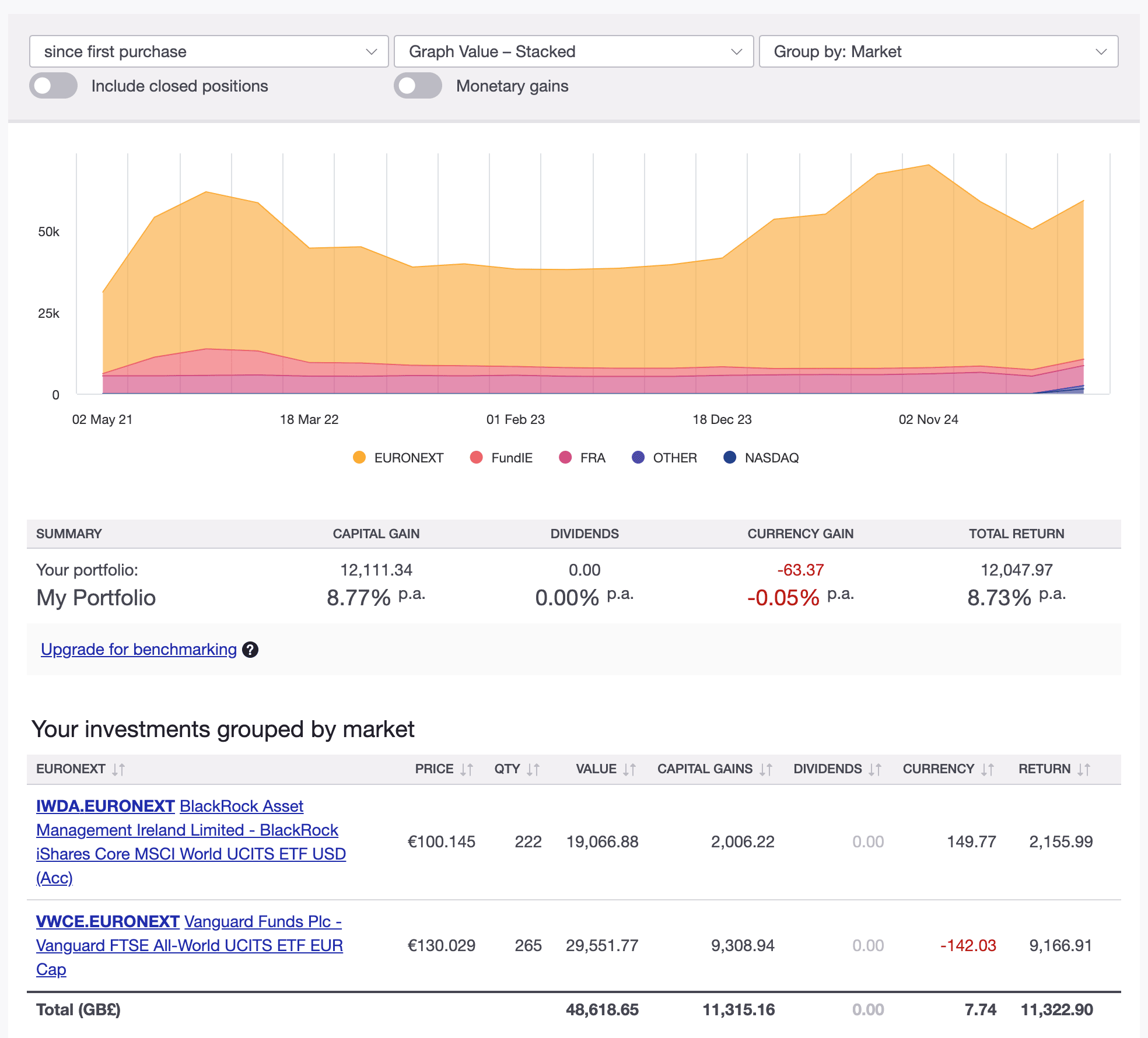 Sharesight dashboard
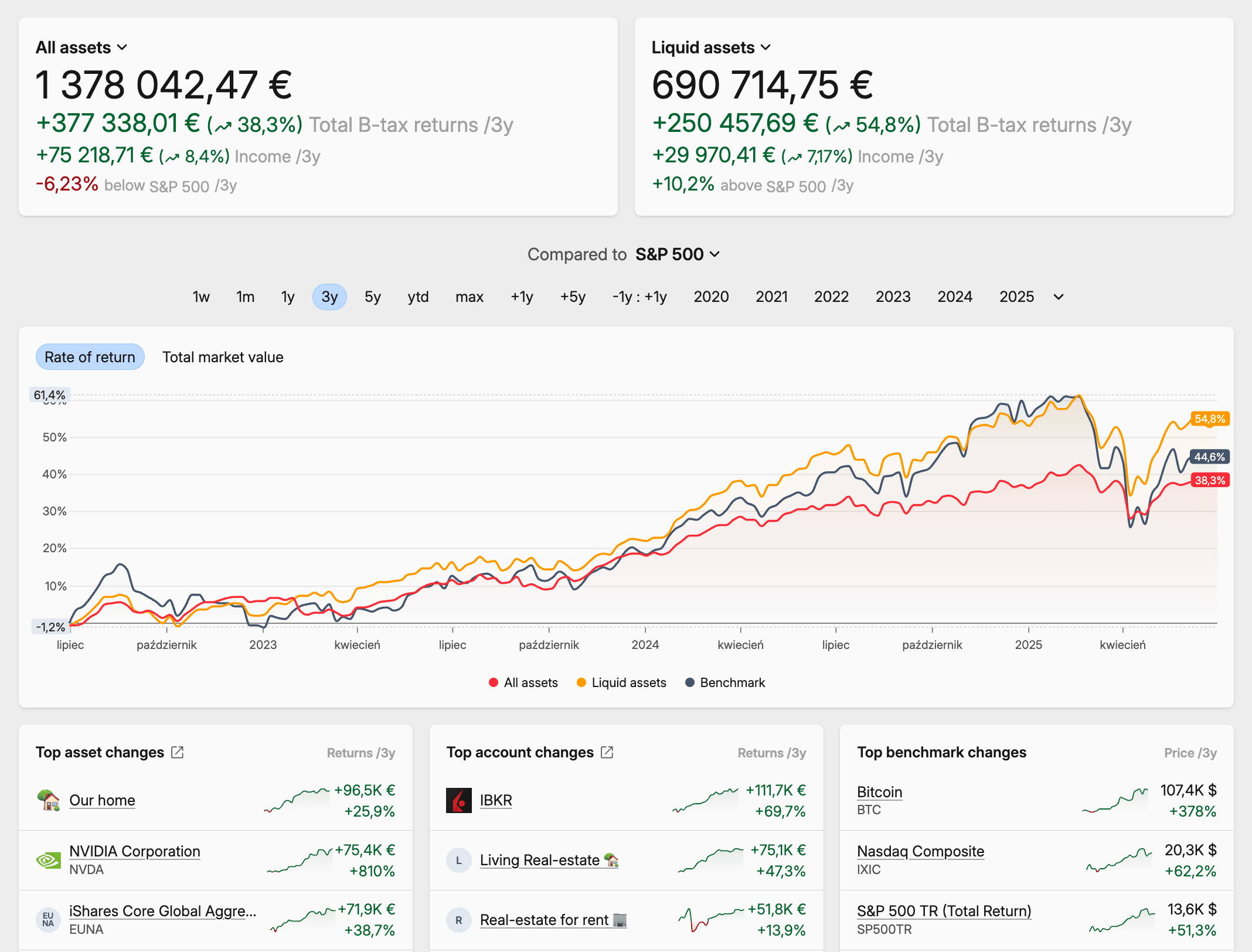 Capitally dashboard
At a glance: Capitally vs Sharesight
Capitally and Sharesight share a foundation — performance reporting, automatic dividend tracking, DRIP support, multi-currency handling and capital-gains tax tools — but they diverge on privacy, asset breadth and how you get data in. Capitally encrypts everything on your device and tracks almost any asset class; Sharesight keeps data server-side and automates dividend and tax tracking for listed securities in a handful of countries.
Feature | Capitally | Sharesight |
|---|---|---|
Asset coverage | Stocks, ETFs, funds, bonds, crypto, commodities, real estate, managed funds, private equity, art, collectibles, P2P loans, mortgages, derivatives, custom assets | Stocks, ETFs, funds, crypto, bonds, precious metals, custom assets |
Options & short positions | Full options support with Greeks, multi-leg strategies, short and leveraged positions | Covered warrants and derivatives on most exchanges; no option strategies or short positions |
Liabilities | First-class loans, mortgages and margin, with automatic interest and a Debt Ratio metric | ❌ Not tracked |
Privacy model | On-device, end-to-end (zero-knowledge) encryption; no aggregator; no third-party trackers or ads | Standard server-side encryption; SOC 2 Type 2 certified; in-app marketing trackers |
Data import | Manual statement import from 70+ brokers; reusable column-mapping importer; one-click undo | Auto-sync for ~240 brokers via trade-confirmation emails and some APIs; manual CSV |
Multi-currency | Mix currencies freely; switch base currency anytime | Converted to one base currency, fixed per portfolio at creation |
Tax reporting | Capital-gains presets for 11 jurisdictions; six cost-basis methods; custom tax rules; tax-loss harvesting | Country-specific reports for AU, NZ, CA, UK and US; FIFO, LIFO, Minimise Gain |
Performance analytics | Portfolio Explorer with live filtering; custom charts; up to 10 benchmarks; FX and inflation attribution | Predefined reports including Drawdown Risk and ETF look-through; limited customisation |
Mobile & offline | Installable web app (PWA); works fully offline | Native iOS and Android apps; no offline mode |
Maturity | Founded 2023; faster release cadence, shorter track record | Founded 2007; 500,000+ users, nearly two decades |
Pricing | Three plans, €80 to €250 per year | Free plan, then about $84 to $279 per year |
Free access | 14-day full-feature trial, no card, anonymous demo | Free plan (10 holdings), 7-day trial, anonymous demo |
In one line: choose Capitally for breadth, privacy and analytical depth; choose Sharesight for hands-off dividend and tax automation if you invest in listed securities within its supported tax regions.
Which is more private, Capitally or Sharesight?
Capitally is the more private of the two. It uses on-device, end-to-end encryption, where your financial data is encrypted with a key derived from your password that never leaves your device. No one at Capitally can read it, because every calculation runs locally. Sharesight uses standard server-side encryption — your data is protected in transit and at rest, but it is processed in readable form on Sharesight's servers.
Sharesight has invested in this model: it earned SOC 2 Type 2 certification in May 2025, covering security, processing integrity and privacy. That is a real, audited credential, and more than many trackers can show. But the architecture still means your decrypted financial data exists on a company's servers, reachable in principle by employees or by anyone who breaches them. Sharesight also has no one-click "export everything" — you can only export individual reports.
There is a second, more concrete gap. As of May 2026, Sharesight's web app loads third-party marketing trackers — Meta Pixel, the LinkedIn Insight Tag, Reddit Ads, Taboola and Bing UET — and its cookie policy adds Google Ads, Mixpanel, Intercom and Segment on top of those. Capitally runs no third-party trackers and no ads inside the app, and lets you export your full dataset at any time. For investors who treat their portfolio as private information, that difference is the whole point.
Capitally's privacy model has one honest cost: because the company never holds your key, a lost password means lost data, with no vendor-side recovery. Keep a backup of your password.
Asset and liability coverage: which tracks more?
Capitally tracks a wider range of assets, and it is the only one of the two that tracks liabilities. It treats stocks, ETFs, funds, bonds, crypto, real estate, private equity, art, collectibles, P2P loans, derivatives and stock options as first-class asset types — and it tracks loans, mortgages and margin as first-class liabilities, with automatic interest accrual, amortisation schedules and a Debt Ratio metric. Sharesight focuses on listed securities and does not track liabilities at all.
Sharesight has genuinely broadened its asset coverage. Through 2025 and 2026 it added a dedicated Real Estate investment type, precious metals, covered warrants and derivatives, and fixed income — more than 20,000 LSE-listed bonds plus US bonds on the NASDAQ and NYSE. Crypto is officially supported. But real estate, private equity and art remain manual "custom investments": you update their value by hand, one entry at a time, and they sit slightly apart from the built-in asset types.
The clearest divide is options and short positions. Capitally tracks individual options and multi-leg strategies — covered calls, spreads, iron condors — with full Greeks, using Black-Scholes-Merton and Barone-Adesi-Whaley pricing, and it handles short and leveraged positions natively. Sharesight does not track option strategies or short positions. If options or leverage are part of how you invest, this difference is decisive.
For a listed-securities investor, Sharesight's coverage is now perfectly adequate. For anyone holding property with a mortgage, a private equity stake, an options book, or simply a portfolio that refuses to fit neat categories, Capitally is built for that portfolio and Sharesight is not.
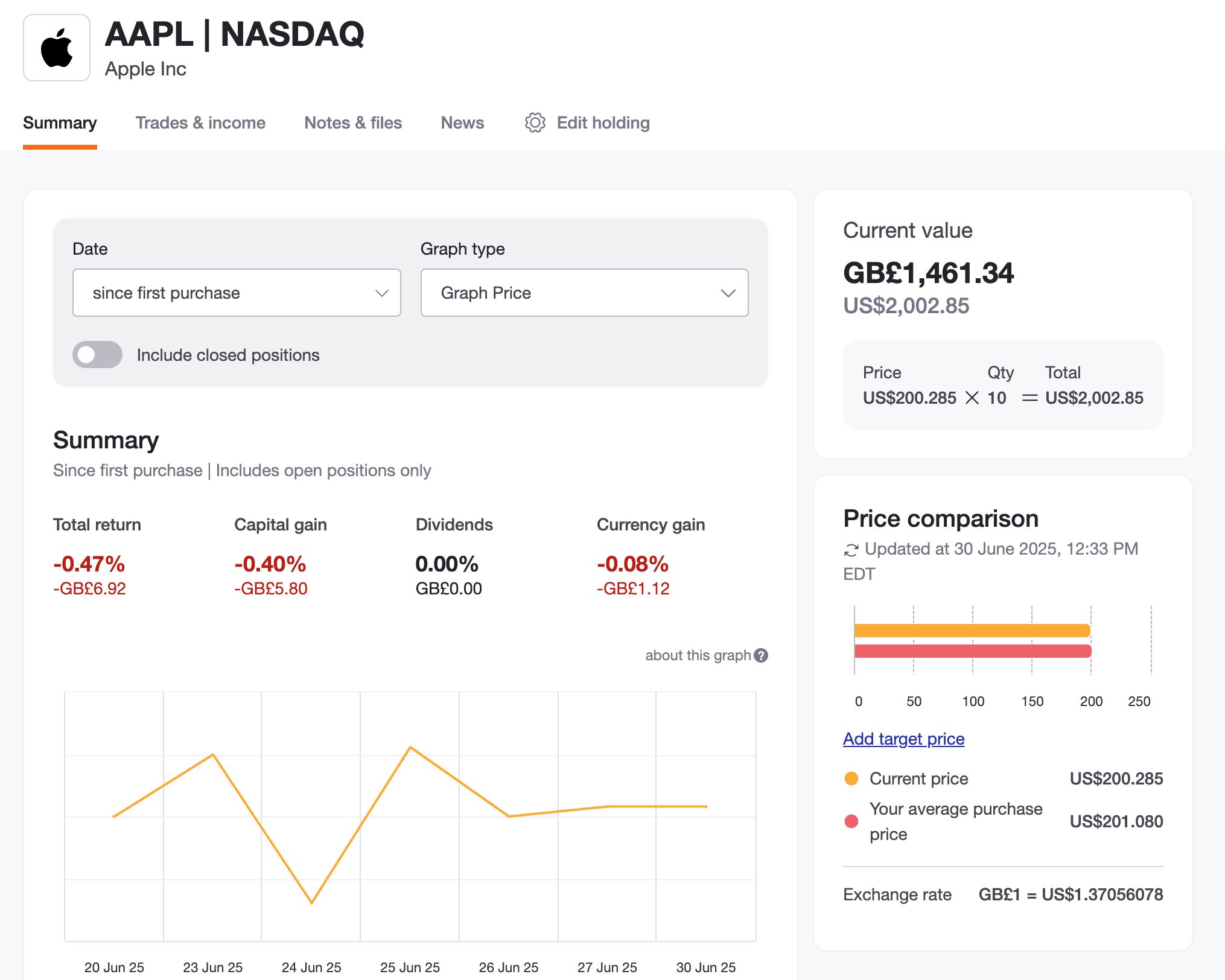 Sharesight asset screen
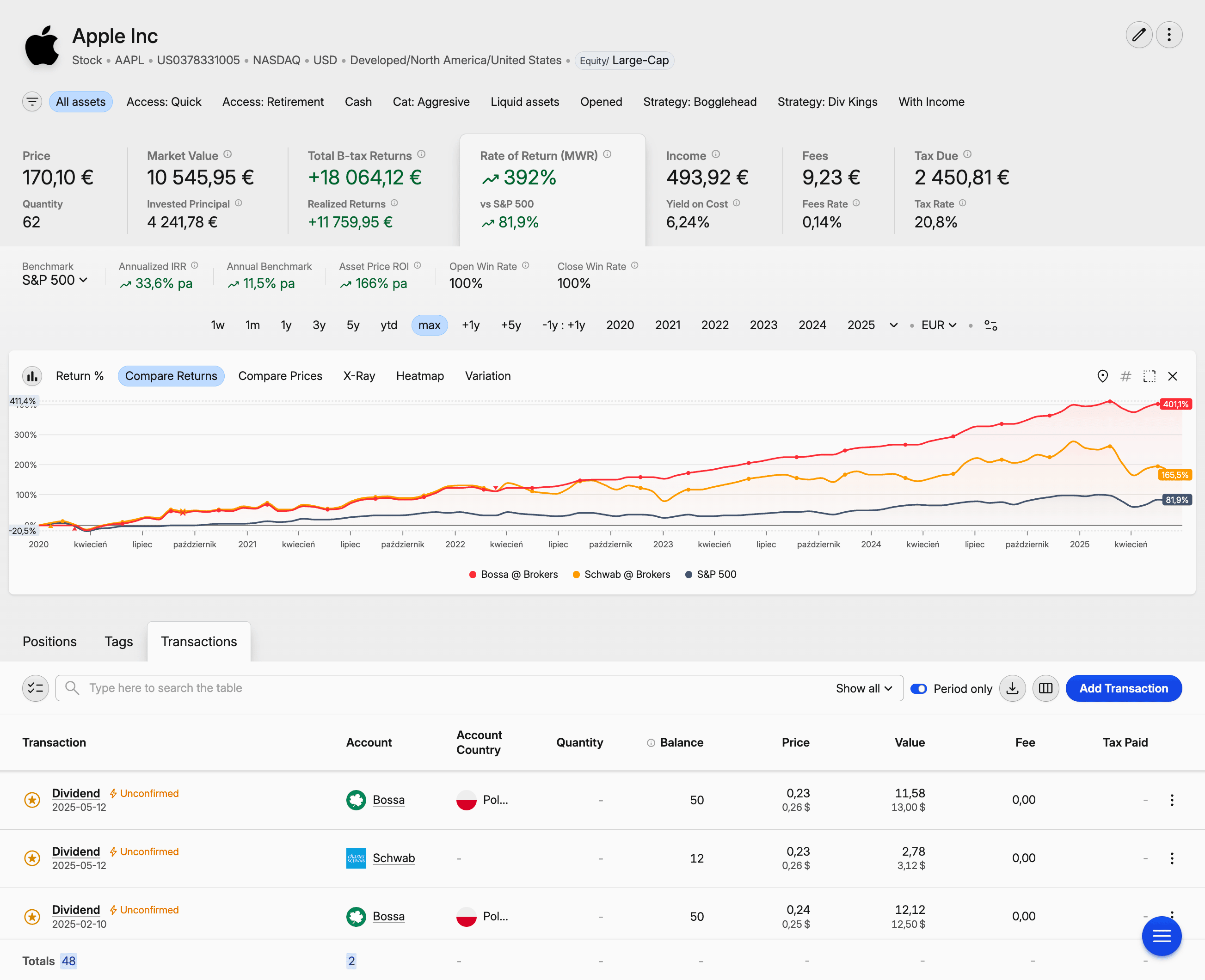 Capitally asset screen
Performance analysis and reporting
Capitally and Sharesight both calculate the core return metrics — money-weighted return (MWR), time-weighted return (TWR), IRR and ROI — but they present them differently. Capitally is built around the Portfolio Explorer: a pivot-table-and-chart hybrid where you filter, group and re-chart your holdings live, by asset, account, currency, region or category, without reloading a report. Sharesight is built around predefined reports you configure and run one at a time.
Sharesight's reports are strong and getting stronger. The 2025 releases added a Drawdown Risk report, an Exposure report with ETF look-through — so you can see the underlying holdings inside your funds — and a rebuilt Future Income report with three-year forecasts. They are well-designed and reliable. The limitation is customisation: you choose parameters within each report, but you cannot freely build or reshape reports, and on large portfolios the page-by-page workflow can feel slow.
Capitally's analytics go a step further on benchmarking. You can plot up to 10 benchmarks at once — any index, ETF, custom asset or even a slice of your own portfolio — and use a Position-Prices benchmark that answers "what would my return be if I had never traded?". A discount-by option subtracts inflation, a house-price index or a risk-free rate from any return figure, so you can read real returns directly. Sharesight's benchmarking compares against single instruments and does not support blended or custom benchmarks.
Where Sharesight pulls ahead is stock fundamentals and watchlists: it surfaces P/E, EPS and similar figures (for ASX and NZX listings) and offers watchlists with price alerts. Capitally has neither — it is an analysis tool for what you own, not a research or screening tool. Neither platform is a trading tool with technical indicators.
 Sharesight reports
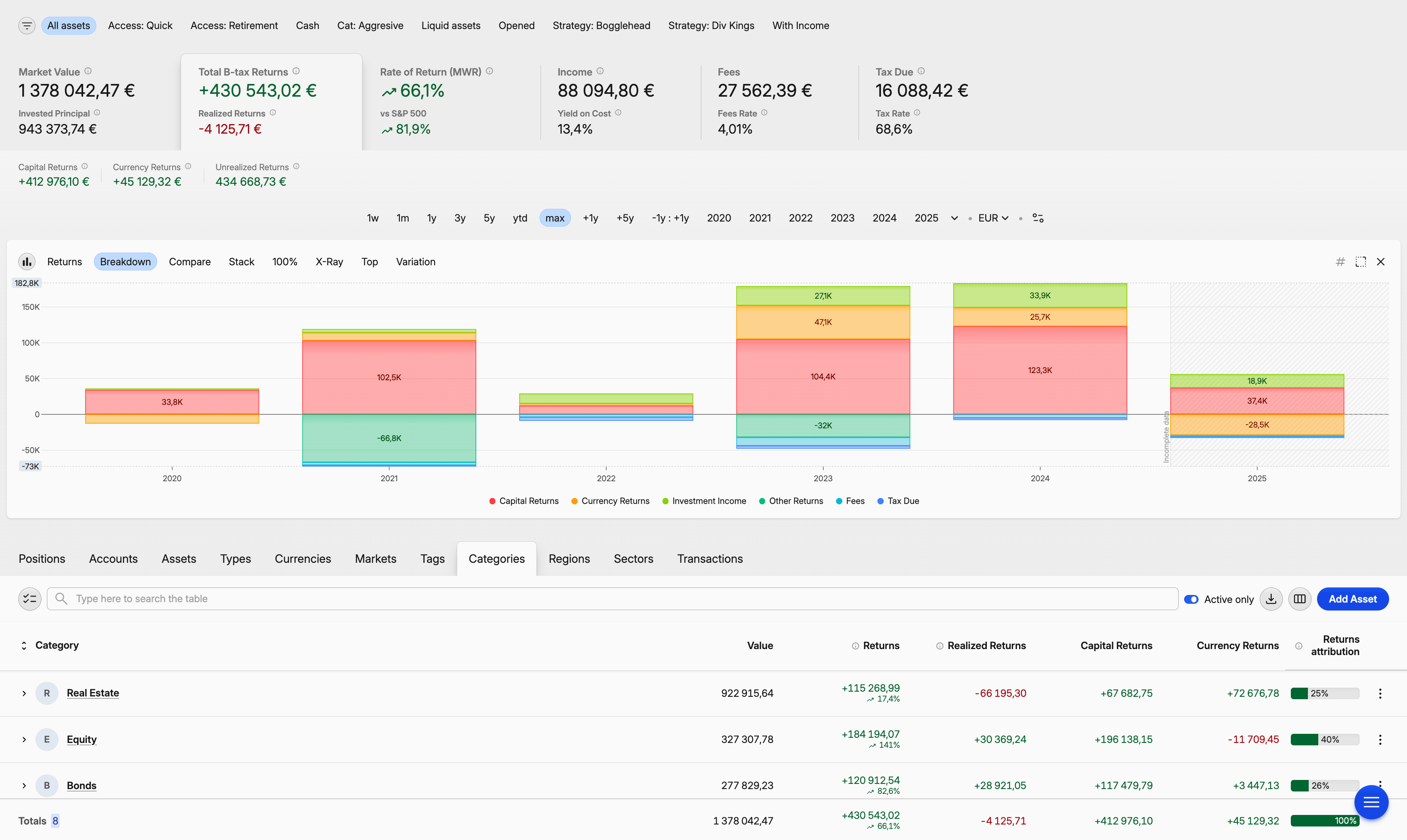 Capitally portfolio explorer
Tax reporting and cost basis
Capitally covers more tax jurisdictions; Sharesight automates a few more deeply. Capitally ships built-in capital-gains presets for 11 countries — the US, UK, Netherlands, Poland, Czech Republic, Australia, Belgium, Canada, Germany, France and Sweden — with six cost-basis methods (FIFO, LIFO, highest-cost, lowest-cost, average cost and manual lot selection) selectable per asset, account or position. It also has a custom tax-rule editor and a tax-loss harvesting tool that shows exactly how many shares to sell for a target tax outcome.
Sharesight's tax reporting is narrower but, within its range, more automated. For Australia, New Zealand, Canada, the UK and the US it produces polished, country-specific reports — Australian capital-gains with FIFO, LIFO and Minimise Gain, US Form 8949 data, and so on — built on its automatic dividend and corporate-action tracking. For an Australian investor at tax time, that automation is hard to beat. Outside those five countries, Sharesight's tax reports become generic capital-gains summaries.
So the honest split: if you file in one of Sharesight's five supported countries and hold mostly listed securities, Sharesight will likely save you a bit more time at tax season. If you file somewhere else, need average-cost basis (for UK Section 104 pooling or Canadian ACB), want to set the cost-basis method per position, or want to model tax-loss harvesting, Capitally's tax engine is the broader and more configurable one.
Data import and broker coverage
Capitally and Sharesight take opposite approaches to getting data in, and the tradeoff is automation versus precision and privacy. Sharesight automatically syncs from around 240 brokers, mostly by reading trade-confirmation emails and through a few direct APIs. Capitally imports broker statements you upload yourself — no automatic sync and no account aggregation, by design — but supports 70+ brokers out of the box.
Sharesight's automation is its headline feature, and for a supported broker it works with little effort. The honest caveats: coverage is strongest in Australia, New Zealand, Canada and the UK; the email-forwarding setup is fiddly; the import-confirmation screen does not show the original data for reference; and transaction or balance discrepancies are commonly reported, so the sync still needs occasional manual checking. There is also no way to save a CSV column mapping — you re-map on every upload — and no quick undo for a bad import.
Capitally's importer is built for control and repeatability. It maps any CSV, Excel or copy-pasted table to transactions, supports formulas and on-the-fly price lookups, and lets you save a mapping as a reusable preset — even one preset targeting several accounts. A pre-import review reconciles assets, accounts and currencies before anything is written, and a bad import can be undone in one click. Because the data comes straight from broker statements, it is high-fidelity enough to use as a source of truth for tax filing — aggregator feeds often drop corporate actions, DRIP runs and FX conversions.
The tradeoff is real and worth stating plainly: Sharesight asks less of you up front; Capitally asks for an upload but gives you cleaner data, fuller history, repeatable imports, and no data shared with a third party.
Multi-currency handling
Capitally has the more flexible multi-currency model. Transactions, prices, fees and reports can all mix currencies; you can switch your viewing or base currency at any time; and a dedicated currency-return metric separates how much of your return came from the asset itself versus from foreign-exchange movement. Sharesight also handles multiple currencies and separates capital from currency gains, but each portfolio's base currency is fixed when you create it and cannot be changed afterwards.
For an investor whose portfolio lives in one currency, that fixed base is a non-issue — Sharesight handles the conversions cleanly. For expats, multi-broker investors, or anyone holding meaningful positions across the euro, dollar and pound, being able to re-base the whole portfolio and read FX attribution as a first-class number is the kind of thing you miss only after you have needed it.
Pricing and plans
Sharesight has a free plan; Capitally does not — but the comparison is more nuanced than that. Sharesight offers a free tier (1 portfolio, 10 holdings), then Starter, Standard and Premium plans running roughly $84, $216 and $279 per year, plus a Business plan for advisors. Capitally has three annual plans: Sailor at €80, Navigator at €130, and Captain at €250.
What each price buys is different. Sharesight's tiers gate features and portfolio counts — Future Income, multi-currency valuation and the Drawdown Risk report appear only from Standard up. Capitally's plans gate capacity and a few advanced areas: Sailor covers the core product within a single project; Navigator adds multiple projects, unlimited assets and the deeper analytics — multiple benchmarks, the Position-Prices benchmark and inflation-discounted returns; and Captain adds options, margin and private-equity tracking on top. Capitally also locks your price for the life of your subscription, even if list prices later rise.
On trials and free access, both now offer a way to try before paying. Sharesight has a free plan, a 7-day trial of its paid features, and an anonymous demo portfolio you can explore without signing up. Capitally has no permanent free tier, but its 14-day trial unlocks every feature and needs no credit card. The practical read: Sharesight lets you linger for free at small scale; Capitally lets you test the whole product properly for two weeks before deciding.
Platforms, maturity and what to expect from neither
Sharesight runs as a web app with native iOS and Android apps, rebuilt in 2025; Capitally runs as an installable web app (PWA) that also works fully offline. Sharesight needs a connection; Capitally does not — useful if you want to analyse your portfolio on a plane, and a side-effect of its on-device model. Sharesight offers API access for developers and integrations; Capitally currently does not.
Capitally is also available in seven languages (English, German, Dutch, Spanish, French, Polish and Portuguese); Sharesight is English-only.
Maturity is a fair point in Sharesight's favour. It has been running since 2007, has more than 500,000 users, and has had nearly two decades to smooth its edges and earn trust. Capitally, founded in 2023, is younger and smaller, with a faster release cadence but a shorter track record. If "has been around a long time" is part of how you judge a tool, Sharesight has the longer history.
Finally, expectations both ways: neither platform is a trading tool. Neither offers technical indicators like RSI or MACD, real-time tick data, or order execution. Both are built for tracking, performance measurement and tax — understanding what you own and how it has done, not timing trades.
Verdict: who should choose which
Both tools are well-built and honest about what they are; the right choice comes down to your portfolio and your priorities.
Choose Sharesight if your portfolio is mostly listed stocks, ETFs and managed funds, you file taxes in Australia, New Zealand, Canada, the UK or the US, and you want dividend tracking and tax reporting to run with as little manual effort as possible. Its automation, its country-specific tax reports and its long track record are genuine strengths, and for a single-currency listed-securities investor in a supported country, it may simply be enough.
Choose Capitally if your portfolio spans multiple asset classes, currencies or accounts — or includes options, private equity, real estate or liabilities — and you want professional-grade analytics, multi-jurisdiction tax tools, and a flexible importer that keeps your data clean. Choose it, too, if data privacy is non-negotiable: on-device, end-to-end encryption with no aggregator and no trackers is the strongest privacy position of any mainstream portfolio tracker, and it is Capitally's reason for existing.
Many investors will find the decision obvious once they look at their own holdings. If your portfolio fits cleanly into listed securities and a supported tax country, Sharesight is a reliable, time-tested choice. If it does not — if it is global, mixed, leveraged, or simply yours alone to see — Capitally is built for exactly that.
Capitally is a strong Sharesight alternative for investors who have outgrown listed-securities tracking. It adds on-device end-to-end encryption, first-class support for options, private equity, real estate and liabilities, capital-gains presets for 11 tax jurisdictions, and a flexible importer with reusable mappings. It is the better fit for diverse, global or privacy-sensitive portfolios; Sharesight remains the better fit if you hold mostly stocks and ETFs and file taxes in Australia, New Zealand, Canada, the UK or the US.
Capitally is more private. It uses on-device, end-to-end (zero-knowledge) encryption, where your data is encrypted with a key derived from your password that never leaves your device, so even Capitally cannot read it. Sharesight uses standard server-side encryption and is SOC 2 Type 2 certified, but your data is processed in readable form on its servers, and its web app loads third-party marketing trackers. Capitally runs no trackers or ads and lets you export all your data at any time.
Choose Sharesight if your portfolio is mostly listed securities and you file taxes in Australia, New Zealand, Canada, the UK or the US, and you want automated dividend and tax tracking. Choose Capitally if you hold multiple currencies, alternative assets, options or liabilities, want professional-grade analytics and multi-jurisdiction tax tools, and prefer on-device encryption over automatic account sync.
Sharesight does not track stock options, option strategies, short positions or liabilities. It added a Real Estate investment type in 2025, but real estate, private equity and art are manual custom investments with hand-updated values. Capitally tracks all of these as first-class asset and liability types — options with Greeks, mortgages and margin with automatic interest, and real estate with rental income.
It depends on plan and portfolio size. Sharesight has a free plan limited to 10 holdings and paid tiers at roughly $7, $18 and $23.25 per month billed annually. Capitally has three annual plans — Sailor at €80, Navigator at €130 and Captain at €250 — with no free tier but a 14-day full-feature trial. At the lower tiers the two are broadly comparable; Capitally's Captain plan, which adds options, margin and private-equity tracking, sits above Sharesight's individual plans.
Yes. Sharesight offers a free plan limited to 10 holdings, a 7-day trial of its paid features, and an anonymous demo portfolio you can explore without signing up. Capitally does not have a permanent free tier, but offers a 14-day trial with every feature unlocked and no credit card required.
Yes. The most reliable way is to import your original broker statements directly into Capitally rather than exporting from Sharesight — broker statements usually go back to account opening and carry every corporate action, dividend and FX conversion intact. Capitally's column-mapping importer handles CSV and Excel files, reconciles assets and accounts before importing, and lets you undo a bad import in one click.