The short version
Capitally, Portfolio Performance, and Ghostfolio are the three portfolio trackers privacy-conscious investors compare most often — none of them connects to your bank login. They are not interchangeable:
- Capitally — the best private portfolio tracker if you want encryption-grade privacy and professional-grade analytics, options, and multi-country tax in one place. Paid, from €80/year.
- Portfolio Performance — the best free, fully local option for desktop users who mostly hold listed securities and are comfortable with a dense, technical interface.
- Ghostfolio — the best choice if open-source code and self-hosting are non-negotiable and you want a clean, minimalist dashboard for a straightforward portfolio.
Table of Contents
- What "private" actually means for a portfolio tracker
- How Capitally, Portfolio Performance, and Ghostfolio compare at a glance
- Privacy and data control
- Convenience, onboarding, and everyday use
- Analytical depth: the returns math each tool can show you
- Asset coverage: tracking everything in one private place
- Tax handling and cost basis
- Price and the value you actually get
- Which private portfolio tracker should you choose?
- Frequently asked questions
If you want a portfolio tracker that keeps your financial data genuinely private, three names come up again and again: Capitally, Portfolio Performance, and Ghostfolio. All three reject the bank-login aggregation that mainstream trackers depend on, so none of them asks you to hand brokerage or banking credentials to a third party.
Where they differ is everything around that privacy. Capitally pairs on-device end-to-end encryption with professional-grade analytics, options, and tax handling. Portfolio Performance is a free, fully local desktop application with a serious analytical core. Ghostfolio is an open-source dashboard built for self-hosting and minimalism. This guide compares all three on privacy, convenience, analytical depth, asset coverage, tax, and price, so you can match the tool to how you actually invest.
What "private" actually means for a portfolio tracker
Capitally defines privacy at the strictest end of the spectrum: on-device end-to-end encryption, where your data is encrypted with a key derived from your password that never reaches Capitally's servers. But "private" is not one thing — across trackers it ranges from "we encrypt our database" to "the vendor mathematically cannot read your data."
It helps to think of four levels of privacy:
- Cloud with at-rest encryption — your data sits on a vendor's server, encrypted, but the vendor holds the keys and can read it. Most mainstream trackers stop here.
- Local-file — your data lives in a file on your own computer and is never sent anywhere. This is how Portfolio Performance works.
- Self-hosted — you run the software on your own server, so the privacy boundary is yours. Ghostfolio supports this, and it is Ghostfolio's strongest privacy mode.
- On-device end-to-end (zero-knowledge) — your data is encrypted on your device with a key only you hold, then synced as ciphertext. This is how Capitally works.
Capitally sits in the zero-knowledge tier: encryption happens on your device, calculations run on your device, and the servers — in the EU, on Google Cloud — only ever hold encrypted data. Portfolio Performance achieves strong privacy by never going online: your portfolio is a local XML or binary file, and the binary format can be password-protected with AES-256. Ghostfolio is privacy-respecting in a different sense — it is open-source, runs no third-party trackers, and allows anonymous sign-up with a security token instead of an email — but its hosted cloud uses standard transport and at-rest encryption, not end-to-end encryption. To get Ghostfolio's strongest privacy, you self-host it.
Bottom line: all three respect your privacy far more than a bank-aggregating tracker. Capitally offers the strongest privacy you do not have to administer yourself; Portfolio Performance is as private as your own hard drive; Ghostfolio is as private as the server you choose to run it on.
How Capitally, Portfolio Performance, and Ghostfolio compare at a glance
Capitally is the broadest of the three: it matches the open-source tools on privacy and goes beyond them on analytics, tax, and asset coverage, in exchange for a subscription. Portfolio Performance and Ghostfolio are free, or nearly so, and do well within narrower scopes. The table below summarises where each tool fits.
Dimension | Capitally | Portfolio Performance | Ghostfolio |
|---|---|---|---|
Privacy model | On-device end-to-end (zero-knowledge) encryption | Local-only files; optional AES-256 password | Open-source, anonymous sign-up; no end-to-end encryption on cloud; self-host for full control |
Hosting & platforms | Web + mobile app (PWA), offline-capable; EU/Google Cloud | Native desktop (Windows/macOS/Linux); read-only mobile companion | Web app + PWA; self-host via Docker; no native iOS app |
Performance metrics | TWR, MWR, IRR, ROI plus period returns | True time-weighted return plus IRR | Time-weighted return only |
Multi-currency | Mix any currencies; separates FX from capital return | Strong; separates currency vs capital gains | 46 currencies; no FX-vs-capital split |
Options & derivatives | Full options support with Greeks and strategies | ❌ | ❌ |
Other assets | Real estate, private equity, loans & mortgages, art, collectibles — first-class | Custom securities only; no native real estate or private equity | Manual entries for real estate and collectibles; no options or shorts |
Tax handling | Capital-gains presets for 11+ countries; 6 cost-basis methods; tax-loss harvesting | FIFO and average cost; no country tax reports | ❌ |
Data import | 70+ broker statement presets; flexible CSV/Excel importer; one-click undo | PDF parsers for 90+ EU brokers; CSV wizard | Fixed-format CSV/JSON; community converters |
Price | From €80/year; 14-day free trial | Free (open-source) | Free self-hosted; cloud Premium about $48 one-time |
Best for | Privacy plus depth, tax, and breadth in one tool | Free, local, EU-broker power users | Open-source and self-hosting minimalists |
Privacy and data control
Capitally gives you the strongest privacy guarantee of the three without asking you to run any infrastructure: on-device end-to-end encryption means your financial data is encrypted before it leaves your device, and Capitally — the company — holds no key and can read nothing. A government request, a server breach, or a rogue employee would all turn up only ciphertext.
In practice: your encryption key is derived from your password and never transmitted, all portfolio calculations run locally in your browser or app, and Capitally's servers — hosted in the EU on Google Cloud, under GDPR — store only encrypted data. There are no ads, no third-party trackers, and no data-driven upselling, and you can export everything at any time, so there is no lock-in. The trade-off is worth stating plainly: because only you hold the key, losing your password means losing access to your data, so keep a backup.
Portfolio Performance reaches privacy from the opposite direction — it never goes online. Your portfolio is a file on your own machine, and nothing is sent to any server run by the project. If you use the read-only mobile companion, you sync that file through your own cloud storage, and the binary file format can be locked with an AES-256 password. For a desktop-only user, this is privacy through the simple absence of a server.
Ghostfolio is genuinely privacy-respecting, along a different axis. It is fully open-source under the AGPL-3.0 licence, runs no third-party trackers or ads, and offers anonymous sign-up — you get a security token instead of handing over an email address. Its hosted cloud, though, uses conventional encryption in transit and at rest, not end-to-end encryption, so the operator can technically read stored data. Ghostfolio's answer is self-hosting: run it in Docker on your own server, and the privacy boundary becomes entirely yours.
Bottom line
For the strongest privacy with the least effort, Capitally's on-device encryption leads. If you want no servers at all, Portfolio Performance's local-file model is hard to beat. If auditable open-source code and self-hosting are your definition of privacy, Ghostfolio is built for that.
Convenience, onboarding, and everyday use
Capitally is the most convenient of the three to live with: it runs as a web and mobile app, imports statements from more than 70 brokers with reusable presets, and lets you undo a bad import in one click. None of these three tools auto-syncs by linking a bank login — that is the deliberate price of privacy — so the real question is how smooth the manual path is.
Capitally is built around making that manual path painless. You export a statement from your broker — Interactive Brokers, Schwab, Degiro, Trading 212, Coinbase and 70-plus others have ready-made presets — and upload it; prices, dividends, and splits are then filled in automatically. A pre-import review screen reconciles accounts and currencies before anything is committed, the import logic is fully editable, and a single click undoes and re-runs an import. For sources without a preset, a flexible importer maps CSV, Excel, or pasted spreadsheet data, with formulas where needed. It works across desktop and mobile as an installable, offline-capable app, in seven languages.
Portfolio Performance is capable but asks more of you. It is a native desktop application for Windows, macOS, and Linux, with PDF statement parsers for more than 90 mostly German and European brokers, plus a CSV import wizard. The interface is dense and built for power users — the project itself describes the learning curve as steep — and its Eclipse-era design shows its age. The mobile companion is read-only: you can view your portfolio on a phone, but not edit it. For an EU investor who likes to see every number and does not mind a technical tool, that density is a feature, not a flaw.
Ghostfolio has the cleanest, most modern interface of the three — deliberately minimalist, with a dark mode and a "Zen mode" that hides monetary values. Onboarding is quick. The friction is in data import: Ghostfolio accepts CSV or JSON only in its own fixed format, so unless your broker's export happens to match, you reshape the file by hand or rely on community-built converter scripts. It is a web app and installable PWA, with an Android wrapper but no native iOS app.
Bottom line
Capitally is the easiest to onboard and maintain across devices; Ghostfolio has the most polished interface but the most rigid import; Portfolio Performance is the most capable for supported EU brokers and the most demanding to learn.
Analytical depth: the returns math each tool can show you
Capitally offers the deepest return analysis of the three: time-weighted return (TWR), money-weighted return (MWR, also called IRR), and ROI side by side, plus FX attribution, options Greeks, and lot-level filtering. Time-weighted return strips out the timing of your deposits to judge your strategy; money-weighted return reflects your actual timing — and seeing both is what separates a serious tracker from a balance check.
Capitally computes TWR, MWR, IRR, and ROI together, with period-return columns from one month to five years for both holdings and the underlying assets. Its Portfolio Explorer is a pivot-table-and-chart hybrid: you filter positions — down to individual lots or multi-leg option strategies — group by account, currency, region, or category, and build custom charts over any period. A "discount-by" option subtracts a benchmark from any return figure, so you can read returns net of inflation, a house-price index, or a risk-free rate. Up to 10 benchmarks can be plotted at once, including built-in economic indicators from Eurostat, the OECD, and the World Bank.
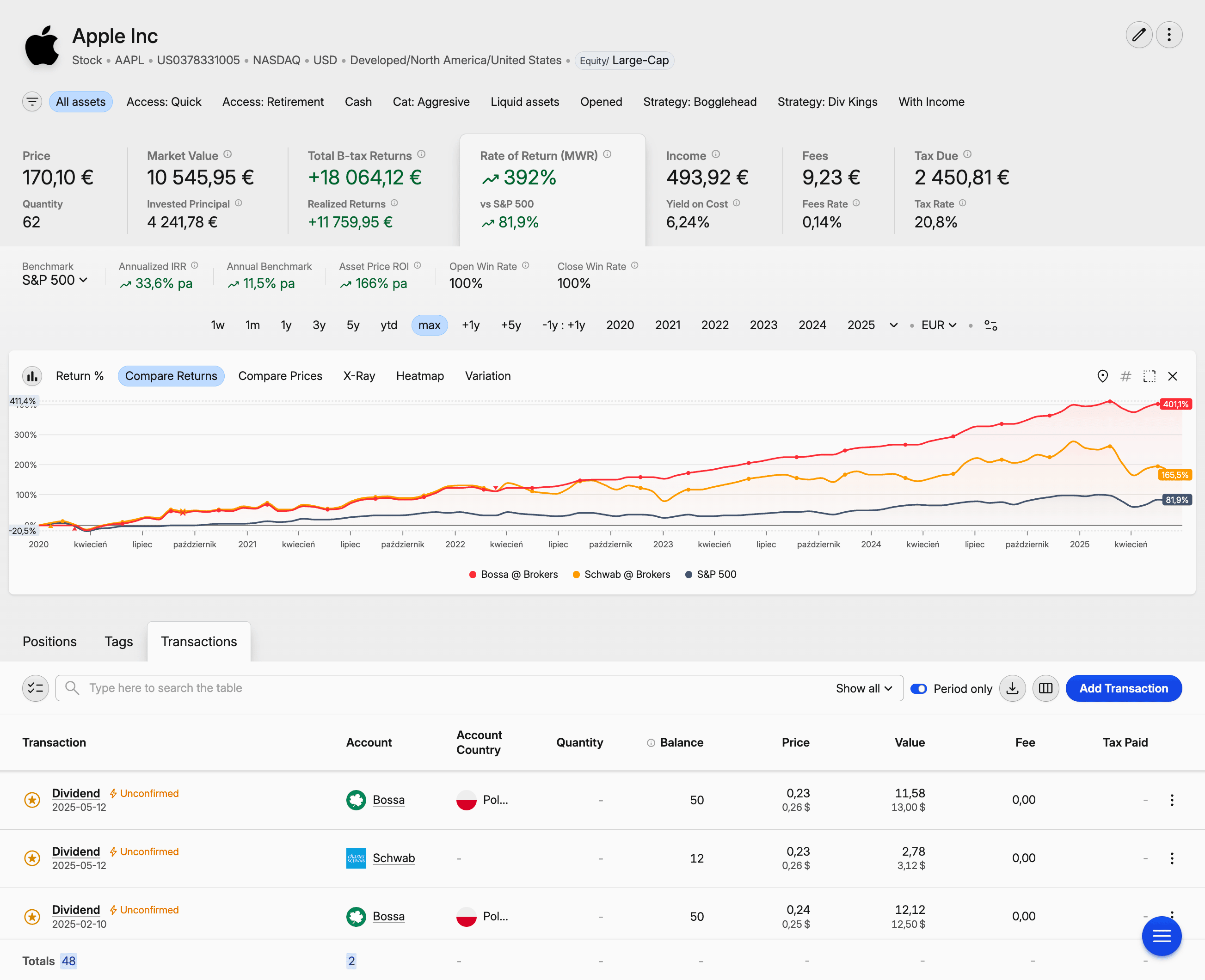 Capitally showing performance metrics, dividends, and a benchmark-comparison chart for a single holding
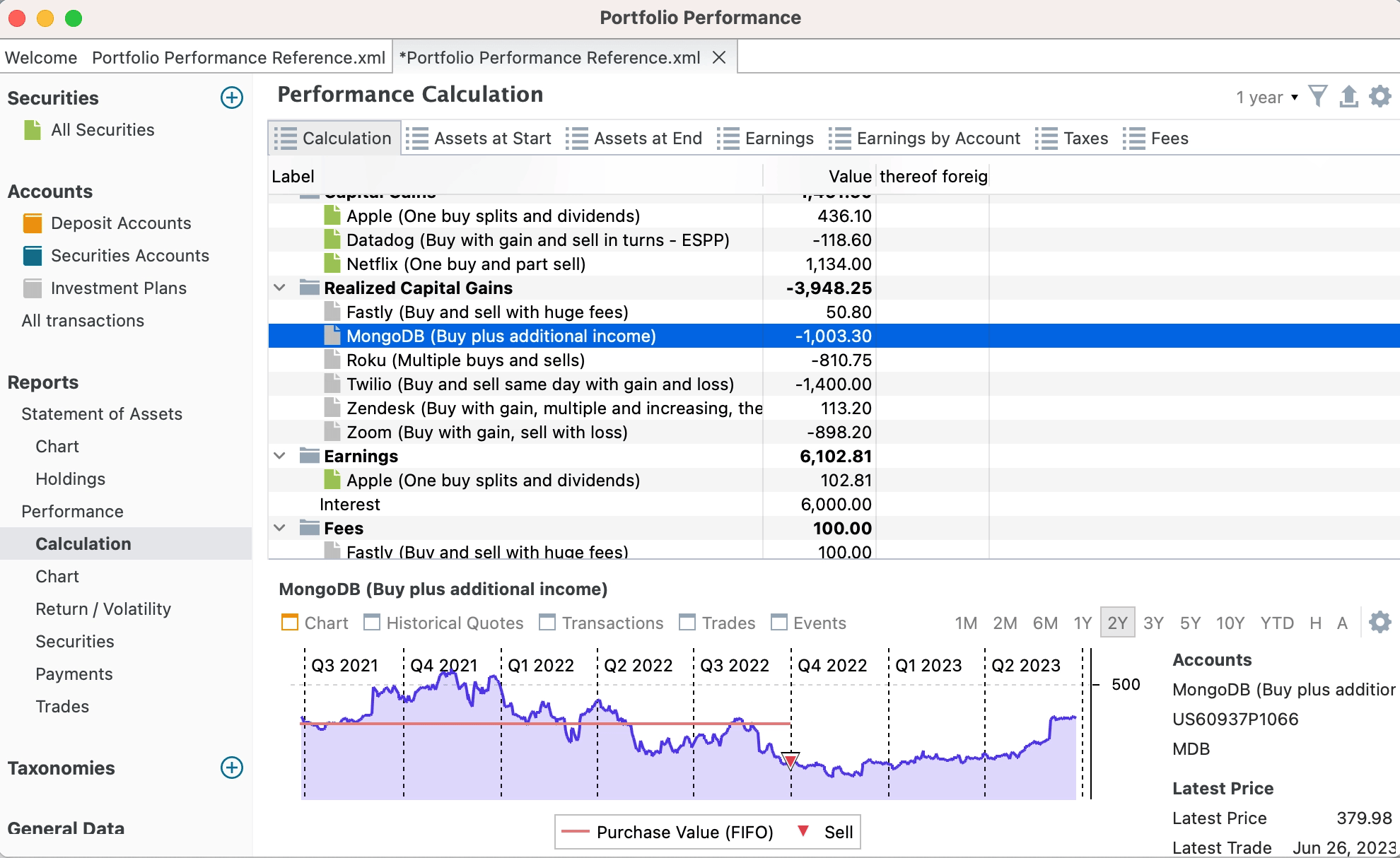
Portfolio Performance is genuinely strong here and deserves credit. It calculates true time-weighted return and IRR over flexible periods, builds dashboards from 48 widgets, and — importantly for international investors — separates capital gains from currency gains in its performance reports. Where it stops short of Capitally is options analysis (no Greeks, only manual workarounds), lot-level tax detail, and the breadth of saveable custom views.
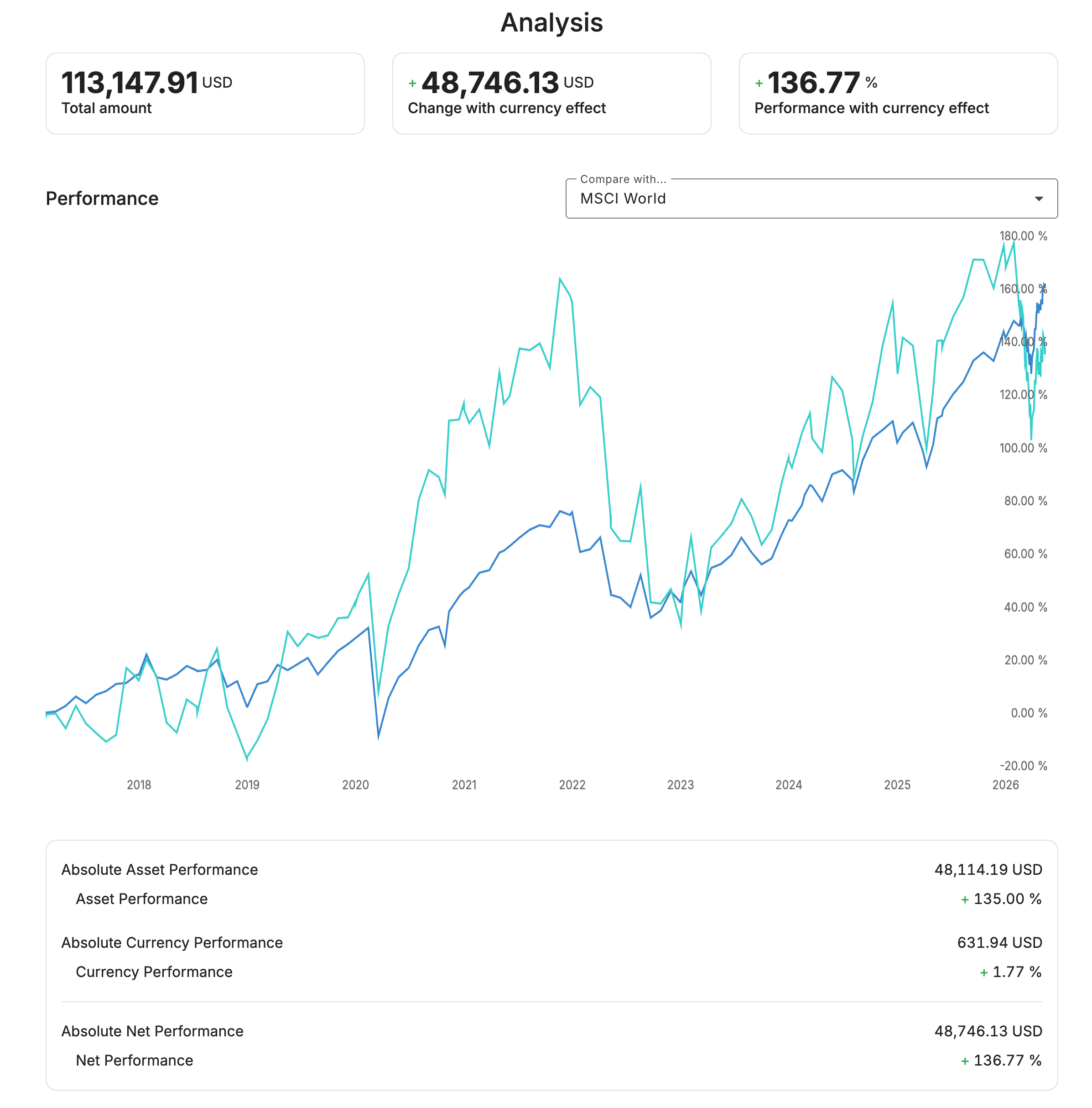
Ghostfolio keeps analysis deliberately simple. It reports time-weighted return only — there is no money-weighted return or IRR, despite long-standing user requests — over a fixed set of periods, with no custom report builder and no grouping or filtering engine. For a buy-and-hold index portfolio that is often enough; for judging individual trades, currency effects, or options, it is not.
Bottom line
Capitally is the clear choice for analytical depth, with Portfolio Performance a strong second for core returns and currency attribution. Ghostfolio is intentionally the lightest, which is fine if a single return number answers your question.
Asset coverage: tracking everything in one private place
Capitally tracks the widest range of assets of the three and treats the difficult ones as first-class: options with full Greeks, private equity with a proper fund lifecycle, real estate with rental income, and loans and mortgages with automatic interest and amortisation. For a privacy-conscious investor whose wealth is not only listed stocks, that breadth is the difference between one tracker and three.
Capitally handles stocks, ETFs, bonds, mutual funds, crypto (including custom tokens), commodities, and roughly 400,000 indexed instruments — and then keeps going: real estate and rentals, private equity as a dedicated asset type with capital calls and distributions, art, collectibles, ventures, peer-to-peer loans, and stock options priced with the Black-Scholes-Merton and Barone-Adesi-Whaley models. Liabilities, margin, and short positions are first-class, with a debt-ratio view and a margin-requirement line.
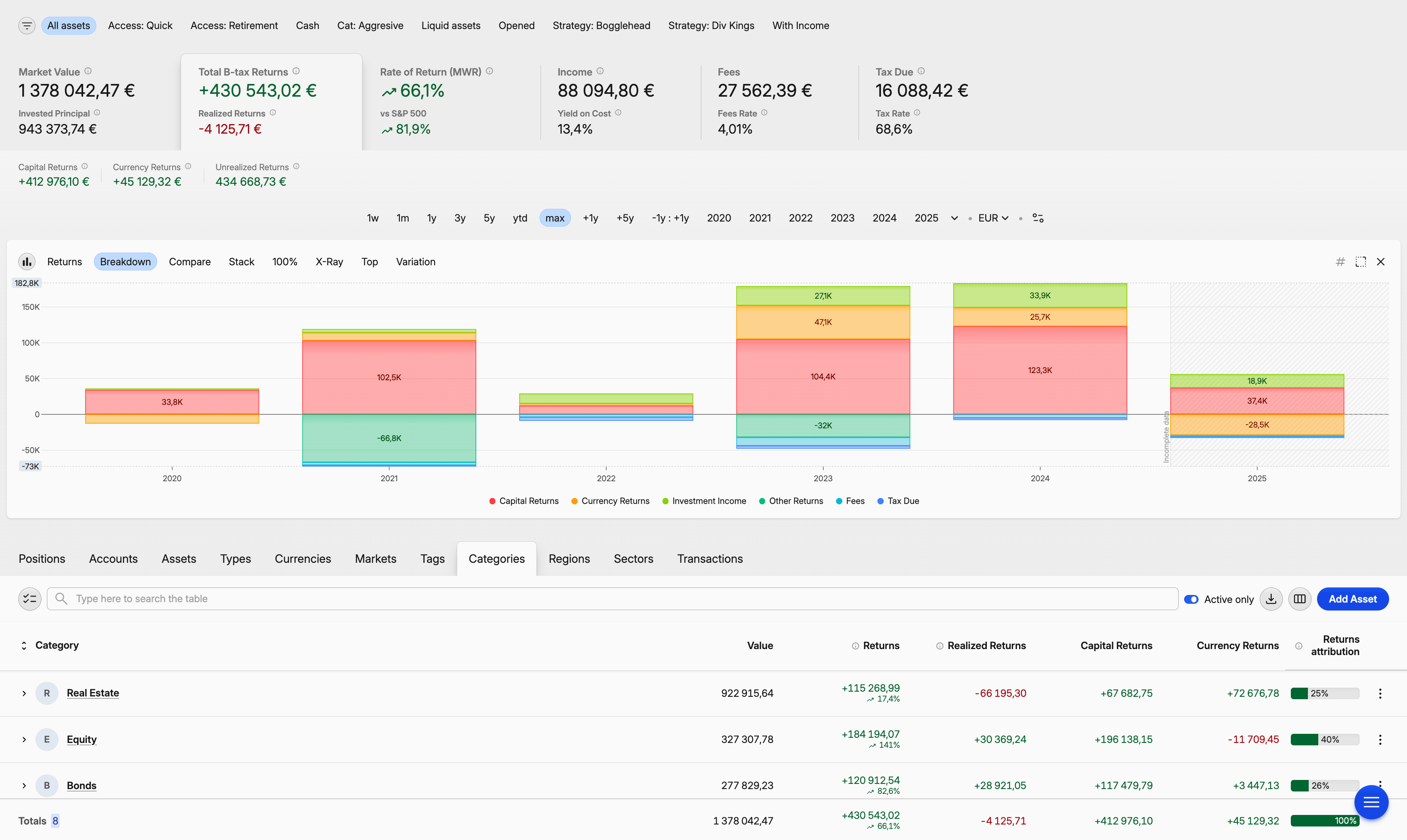 Capitally tracking real estate and bonds alongside listed assets in one portfolio
Portfolio Performance covers listed assets well — stocks, ETFs, funds, bonds, crypto via CoinGecko, precious metals, and anything with a price feed. Beyond that, it relies on generic custom securities with manually entered prices: you can represent a property or a fund that way, but there is no native real estate or private equity type, and no first-class loan or mortgage object. Options exist only as a manual workaround.
Ghostfolio focuses on the core: stocks, ETFs, funds, crypto, and bonds as plain positions. Real estate, gold, and collectibles are tracked as manual entries, and a loan asset subclass was added in 2026 for balance-only liability tracking. There is no options support and no short positions.
Bottom line
If your portfolio is listed securities plus a little crypto, all three can hold it. If it includes options, private equity, real estate with income, or leverage, Capitally is the only one of the three that tracks them natively.
Tax handling and cost basis
Capitally is the only one of the three with built-in capital-gains tax reporting: ready-made presets for more than 11 countries — including the US, UK, Germany, France, Canada, and Australia — six cost-basis methods, and a tax-loss-harvesting view. Portfolio Performance offers basic cost-basis tracking; Ghostfolio offers no tax features at all.
Capitally ships capital-gains presets for the US, UK, Netherlands, Poland, Czech Republic, Australia, Belgium, Canada, Germany, France, and Sweden, each with the correct holding-period rules and default cost-basis method. You can choose FIFO, LIFO, highest-cost, lowest-cost, average cost, or manual lot selection — set per asset, per account, or per position — and a harvestable-quantity column tells you exactly how many shares to sell for a target tax outcome. The tax logic is editable, with a live report preview.
Portfolio Performance supports cost-basis tracking with FIFO and moving-average (average cost) methods, and lets you record withholding taxes per transaction. What it does not do is generate country-specific tax returns or capital-gains reports — it surfaces realised and unrealised gains, but turning those into a filing is your job.
Ghostfolio has no tax functionality: no capital-gains report, no cost-basis methods, no withholding-tax tracking. If you need tax output, you pair Ghostfolio with a separate tool.
Bottom line
For anyone who files capital-gains tax on their investments, Capitally is the only one of the three that does the work inside the tracker. Portfolio Performance gives you the raw numbers; Ghostfolio leaves tax entirely to you.
Price and the value you actually get
Capitally is the only paid tool of the three, starting at €80/year with a 14-day free trial and no credit card required. Portfolio Performance is free and open-source; Ghostfolio is free to self-host, with an optional one-time cloud tier of around $48. The honest question is not which is cheapest — it is what the paid tool gives back.
Portfolio Performance costs nothing: the desktop app is open-source and free forever, with no tiers and no limits. Ghostfolio is free to self-host with unlimited use; its managed cloud has a permanently free Basic tier and a Premium tier at roughly $48 as a one-time payment, not a recurring subscription. Capitally has three plans — Sailor at €80/year, Navigator at €130/year, and Captain at €250/year — each with a fully featured 14-day trial, and your price is locked for the life of the subscription.
What the fee buys is the rest of this article: the multi-country tax engine, options and private-equity tracking, FX attribution, the flexible importer, the cross-device app, and on-device encryption maintained for you. For an investor who would otherwise stitch together a tracker, a tax tool, and a spreadsheet — or who could save more than a year's subscription in a single tax season by harvesting losses correctly — the cost tends to pay for itself. For an investor with a simple portfolio of listed stocks who just wants a private dashboard, that value may not apply, and a free tool is a reasonable, honest choice.
Bottom line
Portfolio Performance and Ghostfolio win on headline price. Capitally wins on value per euro for anyone whose portfolio involves tax, options, alternative assets, or multiple currencies — which is most of the people who choose it.
Which private portfolio tracker should you choose?
Choose Capitally if you want the strongest practical privacy and the analytical depth, tax handling, and asset coverage to run a serious portfolio — it is the one tool of the three that does not make you trade privacy against capability. Choose Portfolio Performance or Ghostfolio if your needs are narrower and a free tool covers them well.
Choose Capitally if you hold multiple currencies, options, real estate, private equity, or liabilities; you file capital-gains tax; you want professional-grade returns analysis such as TWR, MWR, and FX attribution; and you want on-device end-to-end encryption without running your own server. It is built for advanced DIY investors, high-net-worth individuals, and family offices.
Choose Portfolio Performance if you are a desktop-first investor — often in Germany or elsewhere in the EU — who mostly holds listed securities, wants a genuinely free and fully local tool, values capital-versus-currency return attribution, and is comfortable with a dense, technical interface.
Choose Ghostfolio if open-source code and self-hosting are non-negotiable for you, you want a clean and minimalist dashboard, you are content with time-weighted return as your main metric, and you do not need tax reporting, options, or deep analytics.
All three are legitimate, privacy-respecting choices — which is exactly why they keep appearing on the same shortlists. The deciding factor is rarely privacy alone; it is whether you also need depth, tax, and breadth in the same place. If you do, that combination is what Capitally is built for, and the fastest way to find out is to start a free trial — fully featured, 14 days, no credit card.
Frequently asked questions
Capitally is the most private portfolio tracker you do not have to self-host: it uses on-device end-to-end encryption, so your data is encrypted with a key only you hold and Capitally cannot read it. Portfolio Performance is equally private in a different way, storing data only in local files on your own computer. Ghostfolio is most private when you self-host it on your own server.
Open source means the code can be audited, not that your data is encrypted. Portfolio Performance and Ghostfolio are both open-source, which lets anyone inspect how they handle data. But Ghostfolio's hosted cloud still uses standard encryption its operator can read, so only self-hosting makes it fully private. Capitally is not open-source, yet its on-device end-to-end encryption means even Capitally cannot read your data.
No. Self-hosting, as Ghostfolio allows, gives you full control but requires technical setup and ongoing maintenance. Capitally gives you zero-knowledge privacy without self-hosting, because encryption happens on your device automatically. Portfolio Performance keeps data private by staying entirely on your own computer, with no server involved.
Capitally is the only one of these three trackers that handles options with Greeks, real estate with rental income, and private equity as first-class asset types, all under the same on-device encryption as the rest of your portfolio. Portfolio Performance can approximate them with manual custom securities. Ghostfolio tracks real estate as manual entries and does not support options.
Capitally is the only one of the three with built-in capital-gains tax reporting, with presets for more than 11 countries, six cost-basis methods, and tax-loss harvesting. Portfolio Performance offers basic cost-basis tracking with FIFO and average cost but no country-specific tax reports. Ghostfolio has no tax features, so you would pair it with a separate tax tool.
No, and that is by design. Capitally, Portfolio Performance, and Ghostfolio all avoid bank-login aggregation, because handing credentials to an aggregator is exactly the privacy risk their users want to avoid. You import broker statements instead. Capitally makes this the smoothest, with reusable presets for more than 70 brokers and one-click undo.