"Best portfolio tracker for US investors" has three popular answers — Capitally, Empower, and Monarch Money — and the most important thing to know is that they are not the same kind of product.
Capitally is a dedicated investment portfolio tracker built for serious DIY and high-net-worth investors: deep performance and tax analytics, broad asset coverage, and on-device encryption.
Empower (formerly Personal Capital) is a free net-worth dashboard and retirement planner that also serves as the front door to a paid advisory service.
Monarch Money is a budgeting-first household finance app — the most-recommended Mint replacement — with investment tracking as a secondary feature.
That distinction decides most of the comparison. If you weigh these tools as if they were interchangeable, you end up comparing Capitally's subscription against Empower's free dashboard, or Monarch's budgeting against Capitally's tax engine — and miss that each one is built for a different job. So this article does two things: it walks through the seven dimensions that actually decide a portfolio tracker — data coverage, analytical depth, tax support, security, brokerage support, convenience, and overall value — and it says plainly which kind of investor each tool is the right answer for.
One scope note up front: all three are usable by US investors, but only Capitally is built for investors who hold assets outside the US or in more than one currency. We will flag where that changes the recommendation.
Table of Contents
- Quick verdict: which portfolio tracker should you choose
- At a glance: Capitally vs Empower vs Monarch Money
- Data coverage: what each tracker can actually hold
- Analytical depth: measuring performance vs. planning ahead
- Tax support: from cost basis to a filing-ready report
- Security and privacy: who can read your financial data
- Brokerage support: automatic sync vs. manual control
- Convenience and user experience
- Pricing and the value you actually get
- The verdict: which is the best portfolio tracker for you
- Frequently asked questions
Quick verdict: which portfolio tracker should you choose
For most US investors who want serious portfolio analytics, Capitally is the strongest pick of the three — it tracks the widest range of assets, calculates returns and taxes in the most depth, and is the only one with on-device end-to-end encryption. Empower is the better choice if you want a free net-worth-and-retirement dashboard, and Monarch Money is the better choice if your real goal is household budgeting with light investment tracking attached.
Choose Capitally if you want to see your true return after fees, taxes, and currency moves; you hold options, private equity, real estate, crypto, or international assets; you need capital-gains tax reporting; or you want your financial data encrypted so that not even the vendor can read it. It is a paid tool (from €80 a year) and uses manual statement imports rather than automatic bank sync.
Choose Empower if you want a genuinely free dashboard that aggregates your US accounts into one net-worth view, and you value its Retirement Planner, Fee Analyzer, and Investment Checkup. Expect periodic outreach from Empower's advisory team — that is how the free tool is paid for.
Choose Monarch Money if you are a US household that wants budgeting, cash flow, and a shared net-worth dashboard in one app, with investment tracking as a bonus rather than the main event. It connects automatically to 10,000+ US institutions and costs about $100 a year.
At a glance: Capitally vs Empower vs Monarch Money
The table below summarizes how Capitally, Empower, and Monarch Money compare across the dimensions that matter for portfolio tracking. The short version: Capitally leads on asset coverage, analytics, tax, and privacy; Empower and Monarch lead on automatic account syncing and price; and all three are built for different jobs.
Dimension | Capitally | Empower | Monarch Money |
|---|---|---|---|
Product type | Dedicated investment portfolio tracker | Free net-worth dashboard + retirement planner | Budgeting-first household finance app |
Asset coverage | Stocks, ETFs, funds, bonds, crypto, options with Greeks, private equity, real estate, loans and mortgages, collectibles, any custom asset | US stocks, ETFs, and funds; cash; US real estate — everything else a manual "other asset" | US stocks, ETFs, and funds; crypto via Coinbase; real estate and vehicles — foreign equities manual only |
Tax support | Capital-gains presets for 11+ countries; FIFO, LIFO, average cost, specific-lot; tax-loss harvesting; filing-ready report | ❌ None in the free dashboard | ❌ Per-lot cost basis and short/long tagging; no tax-loss harvesting, no year-end report |
Account connection | Manual statement import from 70+ brokers; one-click undo; no aggregator by design | Automatic via Yodlee aggregator; ~14,000 US and Canada institutions | Automatic via Plaid, MX, Finicity; 10,000+ US and Canada institutions (investment sync still in beta) |
Security | On-device end-to-end encryption — Capitally cannot read your data; no ads, no trackers | AES-256, SOC 2; Empower can read your data; advisory-driven business model | AES-256, SOC 2 Type 2; Monarch can read your data; in-app analytics trackers |
Performance analytics | MWR, TWR, IRR, ROI; up to 10 benchmarks; currency vs capital return split; Portfolio Explorer | "You Index" (TWR) plus fixed benchmarks; Retirement Planner with Monte Carlo | Time-weighted return only; no sector or geographic breakdown |
Multi-currency | Full multi-currency with FX attribution | ❌ USD only | ❌ USD only |
Platforms | Web plus installable PWA, works offline; 7 languages | Web plus native iOS and Android | Web plus native iOS and Android; first-class dark mode |
Price | €80–€250 a year; 14-day trial, no card | Dashboard permanently free | $99.99 a year; ~$199 a year Plus add-on |
Best for | Serious DIY and HNW investors; complex, multi-asset, multi-currency portfolios | US investors who want a free net-worth and retirement snapshot | US households that want budgeting plus light investment tracking |
Data coverage: what each tracker can actually hold
Capitally tracks the widest range of assets of the three. Alongside roughly 400,000 indexed stocks, ETFs, funds, and bonds, it handles crypto, options with Greeks, private equity, real estate and rental income, loans and mortgages, collectibles, and any custom asset you define. Empower and Monarch Money cover mainstream US securities well, but treat anything outside that — private equity, foreign stocks, alternatives — as a manually updated "other asset" with no real structure.
In Capitally, the non-mainstream asset types are first-class, not afterthoughts. A rental property tracks its value, its rental income, and the mortgage against it. A private equity stake follows the full LP lifecycle of capital calls and distributions. Options carry put and call pricing with Greeks; loans, mortgages, and short positions are tracked as real liabilities with interest accrual. That breadth is one of Capitally's three core strengths, and it is the dimension where the gap with the other two is widest.
Empower's coverage is built around what its Yodlee aggregator can sync: US-listed stocks, ETFs, and mutual funds inside linked brokerage accounts, bonds held within those accounts, cash, and US real estate valued through Zillow. There is no native crypto, no options tracking, no private equity, and no foreign equities. Anything else goes into a generic "Other Assets" bucket with a manually entered value and no price feed.
Monarch Money covers US stocks, ETFs, mutual funds, and fixed income, plus crypto through a Coinbase connection, real estate via Zillow, and vehicles via VinAudit. Foreign equities can be added manually but cannot be benchmarked alongside US holdings, and options are not tracked as positions. Like Empower, Monarch is a capable tracker for a mainstream US portfolio and a thin one for anything beyond it.
Options, private equity, and other non-mainstream assets
Of the three trackers, only Capitally treats options (with full Greeks), private equity, real estate, and loans as first-class asset types rather than manual line items. If your portfolio includes any of these, it is often the deciding factor — Empower and Monarch can store a value for them, but cannot analyze them.
To be fair to all three: if your portfolio is entirely US stocks and ETFs, every one of these tools will hold it without complaint. The data-coverage gap only matters once your holdings get more varied — and for the investors Capitally is built for, they usually are.
Analytical depth: measuring performance vs. planning ahead
For analyzing investment performance, Capitally goes the deepest. It computes money-weighted and time-weighted return, IRR, and ROI; separates currency gain from capital gain; and lets you compare against up to 10 benchmarks — including a "what if I had never traded" baseline that isolates the value your trading actually added. Monarch Money reports time-weighted return only, with no sector or geographic breakdown. Empower's portfolio analytics are mid-range, but its Retirement Planner with Monte Carlo simulation is genuinely strong — a different kind of analysis Capitally does not try to replicate.
Capitally's analysis happens inside a single Portfolio Explorer — a pivot table merged with charting and deep filtering — where you can break returns down by asset, account, currency, category, region, or industry over any period. It also offers discounted returns, which subtract inflation or any benchmark to show your real return, plus dedicated options analytics. Honest limitation: Capitally does not yet have risk metrics like volatility and Sharpe ratio, a rebalancing engine, or a full backtester — those are on its roadmap, not in the product today. You can read more on the analyze performance page.
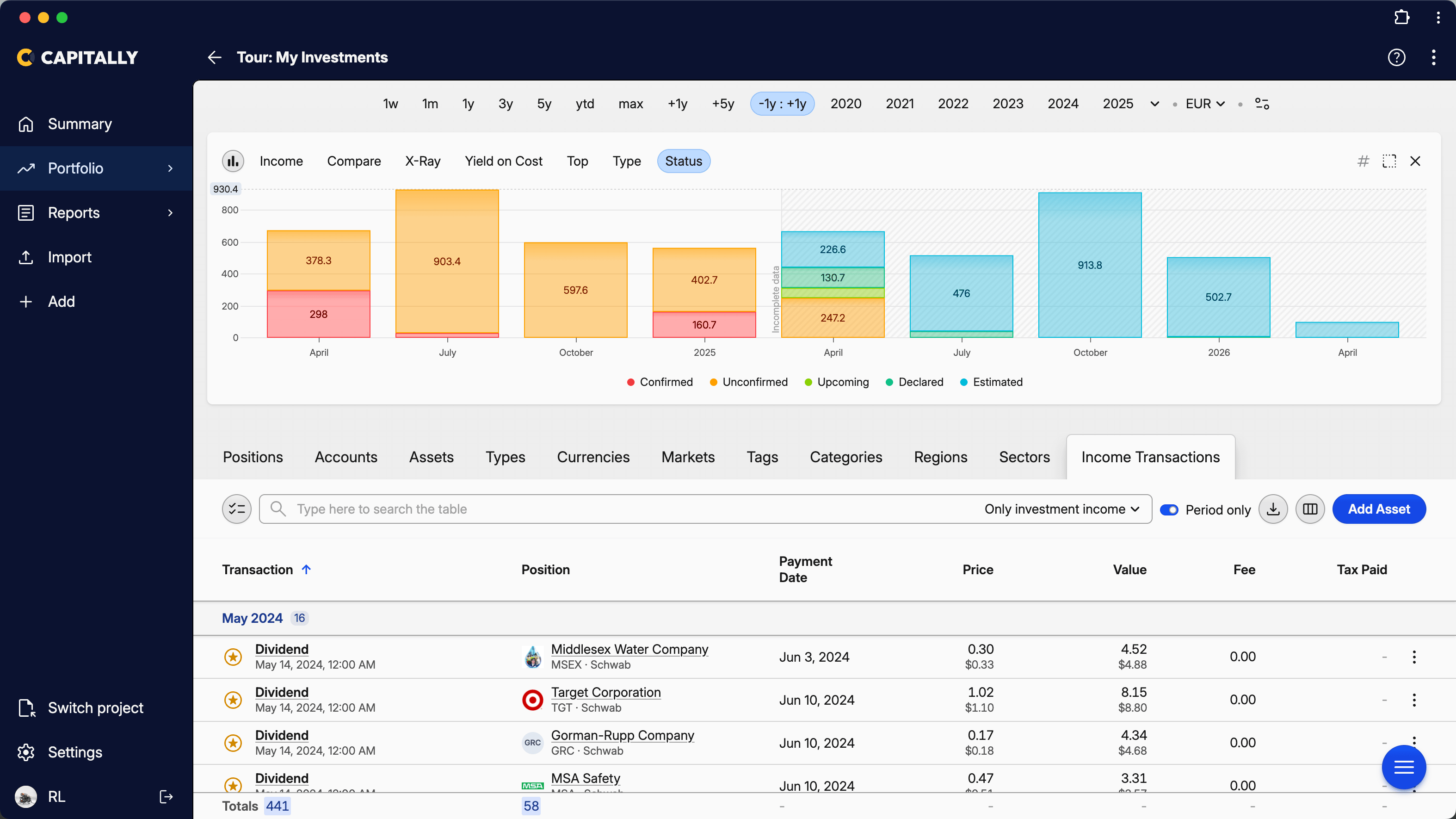 Capitally - Dividend income
Empower's investment analytics center on the "You Index," its name for your time-weighted return, compared against a fixed list of major benchmarks. It adds allocation views, an Investment Checkup that flags drift from a target allocation, a Fee Analyzer, and look-through into the underlying holdings of your funds — a useful feature Capitally does not currently offer. What Empower does not provide is IRR or money-weighted return, custom benchmarks, or per-period comparisons beyond preset ranges. Its standout is forward-looking: the Retirement Planner runs Monte Carlo simulations on your retirement readiness.
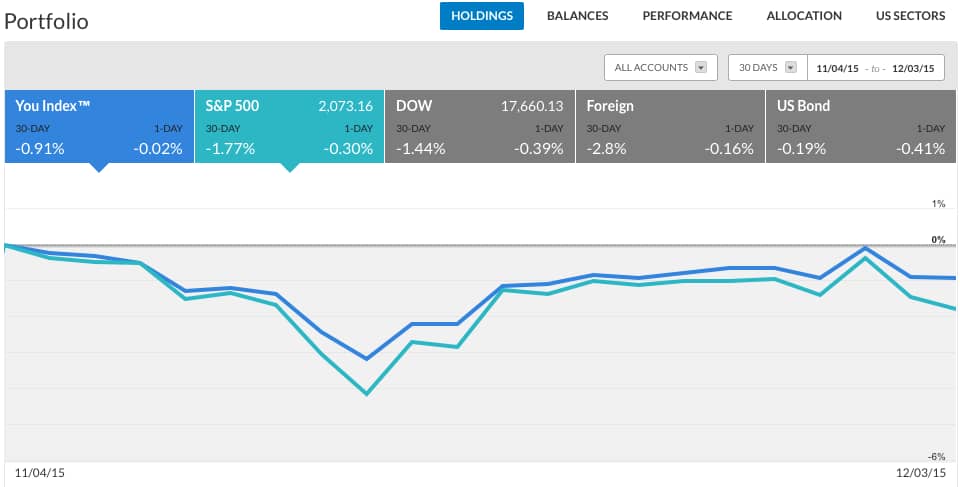 Empower - Holding performance
Monarch Money's analytics are the lightest of the three on the investment side. It reports time-weighted return and a Gains and Losses view with short- and long-term holding periods, and it can overlay a single benchmark such as the S&P 500. It has no sector breakdown, no geographic breakdown, no custom benchmarks, and no risk metrics — Monarch itself is strongest at budgeting and cash-flow analysis, which is a different discipline from portfolio analysis.
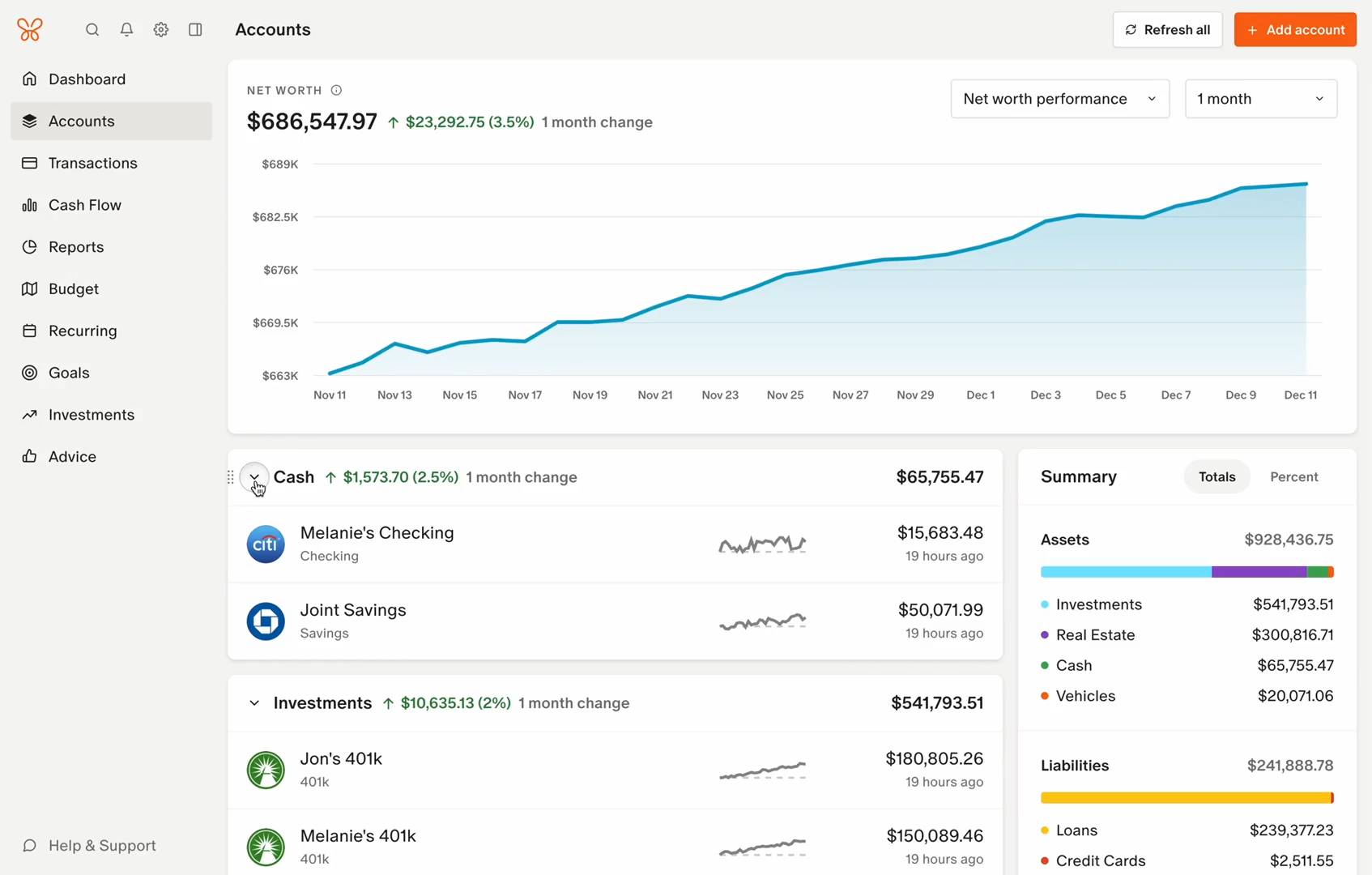 Monarch Money - Dashboard
The honest framing: "analysis" means different things. If it means projecting your retirement, Empower is the most developed. If it means understanding your spending, Monarch is. If it means understanding what your investments actually returned and why, Capitally is — and that is the definition most people mean by a portfolio tracker.
Tax support: from cost basis to a filing-ready report
Capitally is the only one of the three with a real tax engine. It ships capital-gains presets for 11+ jurisdictions including the US, supports multiple cost-basis methods (FIFO, LIFO, average cost, highest-cost, and manual specific-lot selection), suggests tax-loss-harvesting opportunities, tracks withholding tax, and produces a filing-ready tax report. Monarch Money tracks per-lot cost basis and short- versus long-term holding periods but stops there. Empower's free dashboard has essentially no tax tooling.
In Capitally, cost basis can be set at the asset, account, or position level, and the tax rules themselves are editable through a preset editor with a live report preview. A harvestable-quantity column tells you exactly how many shares to sell to reach a target tax benefit, and calculations are settlement-date aware. The output is a report you can hand to an accountant. Honest note: the built-in presets cover 11+ countries well, but if you file somewhere not on that list you will need to configure your own rules — the engine supports it, but it is setup work.
Monarch Money added a Gains and Losses feature in 2025 that records per-lot cost basis and tags holding periods, which is more than most budgeting apps offer. But its cost basis is auto-received from brokerages only about half the time, so manual entry is common, and there is no tax-loss-harvesting guidance, no year-end tax report, and no Form 8949 generation.
Empower's free dashboard surfaces tax-impact estimates inside its Fee Analyzer, but it has no cost-basis editing, no taxable-income report, no withholding tracking, and no country-specific tax rules. Tax-loss harvesting exists at Empower — but only as part of its paid wealth-management service, not the free tool most people use.
Security and privacy: who can read your financial data
Capitally is the only one of the three with on-device end-to-end encryption. Your financial data is encrypted with a key derived from your password that never leaves your device, so Capitally itself cannot read your portfolio — and all calculations run locally. Empower and Monarch Money both use strong, conventional security — AES-256 encryption, SOC 2 certification, read-only aggregator access — but in both cases the vendor's servers can read your data, and both run ad analytics trackers inside the product.
This is the difference between "we promise to protect your data" and "we are not able to read it in the first place." With Capitally, there is no server-side copy of your decrypted portfolio for an employee to view or a breach to expose. The company hosts in the EU under GDPR, runs no ads and no third-party trackers within the app, does not monetize your data, and lets you export everything at any time. You can read how the on-device encryption works in the help center. The honest counterpoint: Capitally is currently not SOC 2 certified, and Empower and Monarch both are — that is a real, audited certification, and its absence is a fair mark against Capitally.
Empower's security is solid on paper: AES-256, SOC 2, and bank credentials that are held by the Yodlee aggregator rather than Empower itself, with read-only access. But there is no end-to-end encryption — Empower and Yodlee can both read your financial data — and the business model is the thing to weigh. Empower's free dashboard exists to route users with $100,000 or more in linked assets to its phone-based advisory team. Your portfolio data is the qualifying signal.
Monarch Money is SOC 2 Type 2 certified, uses AES-256, keeps credentials with its aggregators, supports multi-factor authentication, and — unlike the ad-supported Mint era it replaced — explicitly does not sell user data. But it has no end-to-end encryption either: your data lives in Monarch's cloud where the company can read it, and as of 2026 the app still loads third-party analytics and survey trackers. It is privacy-respecting by mainstream standards, but it is not architecturally private the way Capitally is.
Brokerage support: automatic sync vs. manual control
If you want fully automatic account syncing, Empower and Monarch Money both win here. Empower connects to roughly 14,000 US and Canadian institutions through the Yodlee aggregator, and Monarch connects to more than 10,000 through Plaid, MX, and Finicity. Capitally takes the opposite approach: you import broker statements manually from 70+ supported brokers, with no aggregator by design. That is genuinely more upfront work — traded for three things: data fidelity, privacy, and international reach.
The case for automatic sync is real, and for a US investor whose accounts all sit at mainstream US brokers, it is a meaningful convenience. Two caveats worth knowing: Monarch's investment-transaction sync is still flagged as beta and is off by default, and both tools are US- and Canada-only — neither connects to European, UK, or Australian institutions.
The case for Capitally's manual imports comes down to what aggregators drop. Aggregator feeds often return only current balances or a short transaction window, and routinely miss corporate actions, dividend reinvestments, and currency conversions — exactly the data an accurate cost basis and a defensible tax filing depend on. A broker statement carries all of it. You also never hand over your brokerage credentials, and because the importers are reusable and editable, the work is front-loaded, not recurring. Misimports can be undone in one click. Capitally also consolidates accounts from brokers worldwide, which the aggregator-based tools cannot. See how Capitally brings every account into one place.
The honest verdict on this dimension: if your accounts are all at mainstream US brokers and you want set-and-forget, Empower or Monarch's automatic sync is a genuine advantage over Capitally. If you care about accurate cost basis for tax filing, or you hold any account outside the US, Capitally's manual imports are the more reliable choice.
Convenience and user experience
Monarch Money has the most polished day-to-day experience of the three — a clean interface, and native iOS and Android apps with home-screen widgets. Empower's mobile apps are capable, but its dashboard design feels dated. Capitally is a customizable, exploration-first web app delivered as an installable PWA that works offline and ships in 7 languages — flexible and powerful, with a steeper initial learning curve than Monarch.
Monarch's standout convenience feature is genuinely its own: a shared household subscription that lets a partner and a financial advisor join at no extra cost, with everything rolling into one dashboard. It is English-only and has no offline mode, but for couples managing money together it is the smoothest option here.
Empower's strongest UX moment is onboarding — linking accounts and seeing a net-worth picture appear is fast and satisfying. Daily use is heavier: the dashboard has a dense, 2015-era aesthetic, there is no dark mode, and customization is limited.
Capitally is built for investors who want to be in control of their view. Tables, charts, date periods, importers, tax presets, even menus are customizable, and the same interface works across desktop and mobile as an installable PWA that runs offline. The honest tradeoff: that flexibility means a steeper start than Monarch's guided simplicity, there is no native app-store app, and Capitally deliberately does not do budgeting. It rewards the investor who treats an annual portfolio review like an audit — not the one who wants a minimal, hands-off app.
Pricing and the value you actually get
On sticker price, Empower wins outright — its dashboard is permanently free — and Monarch Money costs about $100 a year. Capitally costs €80–€250 a year and has no free tier. But price and value are different questions: Empower is monetized by routing you toward a paid advisory service, Monarch's value is household budgeting, and Capitally's value is decision quality — the tax, currency, and return clarity a paid portfolio tracker is supposed to deliver.
Empower's Personal Dashboard is free with no plan tiers. The cost is indirect: the advisory funnel (0.49 to 0.89 percent of assets under management, with a $100,000 minimum) and the outreach that comes with qualifying for it. Free is accurate — but it has a business model attached.
Monarch Money is $99.99 a year for Core, with a roughly $199 a year Plus add-on that unlocks forecasting and deeper investment analysis. For a household budgeting app with investment tracking attached, that is reasonably priced.
Capitally has three tiers — Sailor at €80, Navigator at €130, and Captain at €250 a year — with a 14-day trial that needs no credit card, and a price-lock so your rate does not rise while you stay subscribed. Every tier includes every feature; the tiers differ only on capacity. The way to judge that cost is by derived value: a portfolio tracker pays for itself when better decisions — catching a tax-loss-harvesting window, seeing that a strong year was mostly a currency move, knowing your real return after inflation — save or earn you more than the subscription. That is the lens Capitally is built for, and it is a different lens than the one that compares it to a free dashboard. See the full pricing breakdown.
The verdict: which is the best portfolio tracker for you
Capitally is the strongest dedicated portfolio tracker of the three. Choose it if you want professional-grade return and tax analytics, hold a complex or multi-currency portfolio, track assets beyond mainstream US securities, or want on-device encryption that keeps your data unreadable to the vendor. The tradeoff is a paid subscription and manual statement imports — a fair price for fidelity and control. If that fits, start a 14-day Capitally trial with no credit card, or see how it stacks up against other dedicated trackers in our review of the best portfolio trackers for DIY investors.
Empower is the best free choice for US investors with mainstream accounts who want a net-worth and retirement-planning view rather than a tax and analytics engine — and who do not mind that qualifying balances bring advisor outreach.
Monarch Money is the best choice for US households that want budgeting, cash flow, and a shared net-worth dashboard in one well-designed app, with investment tracking as a supporting feature rather than the core.
Frequently asked questions
Quick answers to the questions US investors most often ask when choosing between Capitally, Empower, and Monarch Money.
Yes — Capitally is a strong alternative for investors who want more than a net-worth snapshot. It adds capital-gains tax reporting, money- and time-weighted returns, multi-currency FX attribution, and on-device encryption that Empower's free dashboard does not offer. Empower remains the better pick if you mainly want a free retirement planner and automatic account aggregation.
Monarch Money tracks investment balances, holdings, and per-lot cost basis, but it reports time-weighted return only and has no sector or geographic breakdown, no custom benchmarks, and no tax report. It is built as a budgeting app first, so for serious portfolio analysis Capitally goes considerably deeper.
Capitally is the only one of the three built for international portfolios. It supports brokers worldwide, handles any currency, and separates currency gain from capital gain. Empower and Monarch Money are both USD-only and connect to US and Canadian institutions only.
Empower and Monarch Money connect automatically through aggregators — Yodlee for Empower, and Plaid, MX, and Finicity for Monarch. Capitally does not use an aggregator by design: you import broker statements manually, which keeps your credentials private and produces higher-fidelity data for tax filing.
Capitally is the most private of the three. It uses on-device end-to-end encryption, so the company itself cannot read your financial data, and it runs no ads or third-party trackers. Empower and Monarch Money both use strong conventional security and are SOC 2 certified, but their servers can read your data.
It depends on what you need. Empower's free dashboard is enough for a net-worth and retirement overview. A paid tracker like Capitally is worth it when better decisions — tax-loss harvesting, real return after inflation and currency moves, accurate cost basis — save or earn you more than the subscription costs.