myFund and Capitally represent two different approaches to the same goal: how to keep all your investments in one place and truly understand their performance. myFund has been operating since 2009 and is the oldest and most affordable Polish portfolio tracker — it provides the deepest integration for Polish retirement accounts (IKE, IKZE, PPK, OFE, PPE) and tax reporting (PIT-38). Capitally is a modern application built in 2023 with a focus on four pillars: privacy (end-to-end encryption on your device), comprehensive asset coverage, multi-currency analytics, and multi-jurisdictional tax support — making it the go-to for investors with foreign brokers and complex portfolios.
This article compares both applications based on the factors that matter most to the Polish investor: local market coverage, tax features, broker integrations, as well as usability, analytical depth, and the real value provided for your money. If you are looking for a broader overview of the category, we also have a separate ranking of portfolio trackers for DIY investors.
The short answer: the right choice depends on what your portfolio looks like. If you invest primarily through Polish brokerage and retirement accounts and don't mind a less intuitive interface, myFund is hard to beat on price and its alignment with Polish requirements. If you have accounts with foreign brokers, invest in multiple currencies, hold alternative assets, or prioritize privacy and modern analytics, Capitally will be the better choice. We break down the details below.
Table of Contents
- Capitally vs myFund: comparison table
- Privacy and data security
- Analytical depth and portfolio insights
- Interface and ease of use
- Polish market coverage and asset classes
- Tax handling: PIT-38, foreign dividends, IKE/IKZE
- Brokers and data import
- Pricing and real value
- What you won't find in either app
- How to move from myFund to Capitally
- Verdict: who is Capitally for, and who is myFund for?
Capitally vs myFund: comparison table
The following table compares Capitally and myFund in areas that most often determine your choice. Below the table, we elaborate on each point — with an honest assessment of which application wins in each category.
Feature | myFund | Capitally |
|---|---|---|
For whom | Investors focused on the Warsaw Stock Exchange (GPW), mutual funds, and IKE/IKZE/PPK accounts | Investors with foreign brokers, multiple currencies, and complex portfolios |
Market presence | A Polish company since 2009 — focused on the Polish market. | Polish company since 2023 — independent startup with international ambitions |
Privacy | Standard server-side encryption, data in a database, hosting in Poland | End-to-end encryption on the device, zero-knowledge model, hosting in Europe |
Polish retirement accounts | Dedicated IKE/IKZE/PPK/OFE/PPE support: contribution limits and automatic valuations | IKE/IKZE/PPK support as account types — no contribution limits or automatic valuations for closed-end funds |
Asset classes | Stocks, ETFs, GPW/NewConnect, Catalyst, Polish investment funds (TFI), crypto, real estate. | Stocks, ETFs, GPW/NewConnect, crypto, real estate, Private Equity, options, liabilities, loans, and short positions. |
Taxes | PIT-38 calculator built for the Polish system, FIFO method | Tax engine for 11 countries (including Poland), 6 cost-basis methods, customizable |
Brokers | Data import from statements of popular Polish brokerages | Data import from statements of popular Polish and international brokerages |
Custom data import | Practically non-existent — "parser per broker" model plus automatic AI import | Flexible import of any CSV, Excel, JSON, and XML file with presets, logic, and formulas |
Analytics | Broad library of ready-made reports, fundamental analysis, stock screener, TradingView | Portfolio Explorer, custom charts, benchmarks with economic indicators, real inflation-adjusted returns |
Interface | Outdated, convoluted menu architecture; old and "new" layouts, both visually outdated | Modern, consistent, exploratory; web app/PWA that works offline |
Pricing | Approx. 36–153 PLN/year; 30-day trial | 80 / 130 / 250 EUR/year; 14-day full trial |
Privacy and data security
Capitally encrypts your financial data end-to-end — directly on your device, using a key derived from your password that never leaves your browser. This is a zero-knowledge model: even the Capitally team cannot read your portfolio. myFund uses standard server-side security — a different, less restrictive trust model.
In Capitally, all calculations happen on your device, servers are located in Europe (Google Cloud, GDPR-compliant), there are no ads or third-party trackers, and you can export your data in its entirety at any time — without being locked into one tool. However, the zero-knowledge model comes at a price: if you forget your password, no one can recover your data, so backups are important.
myFund focuses on data minimalism: you only need a username, password, and email address to create an account — no real name or payment details required. It also features HTTPS, two-factor authentication (2FA via TOTP), and login notifications. The idea is that since the account isn't linked to personal data, nobody can connect it to a specific person — in practice, however, this protection is fragile. Your entire portfolio is stored in a database on the server side, and imported broker statements can themselves contain identifying data: account numbers, transaction identifiers, or descriptions of transfers. The operator technically has access to this data, so the lack of fields in the registration form doesn't change much.
If you do not prioritize privacy, myFund's security measures will suffice for daily use. If, however, the privacy of your financial data is a non-negotiable requirement, Capitally is the only one of these two applications that offers end-to-end encryption — no one but you can read your data, even in the event of a server-side breach.
Analytical depth and portfolio insights
Capitally focuses on interactive analytics: the core of the app is the Portfolio Explorer—a hybrid of a pivot table and pivot chart where you can filter, group, and change metrics without reloading the page. myFund takes a different approach, providing a very extensive library of pre-built reports, but without the ability to save your own custom ones.
Capitally calculates returns using MWR/IRR, TWR, and ROI methods, with the option to quickly select any time period. It builds its own charts (line, bar, X-Ray, heatmaps, treemaps) and allows you to compare up to 10 benchmarks side-by-side—including economic indicators (inflation, interest rates, real estate price indices) from Eurostat, the OECD, and the World Bank for over 60 countries. It can also discount returns, showing real returns after subtracting inflation or any chosen benchmark. If you trade options, they are fully supported, including "the Greeks."
myFund has a truly extensive library of reports: portfolio structure, statistics, rolling returns, drawdowns, volatility, heatmaps, dividend analysis over time, and tracking of IKE/IKZE/PPK limits. It also features something Capitally does not: fundamental company analysis, a stock screener with over 100 metrics, and full integration with TradingView for technical analysis. Its weakness is a lack of flexibility—you cannot save your own reports or build your own charts; you work with what the creator has provided.
If you want to drill down into data and arrange your own views, Capitally gives you more freedom. If you prioritize fundamental and technical analysis of individual companies, myFund holds the advantage.
Interface and ease of use
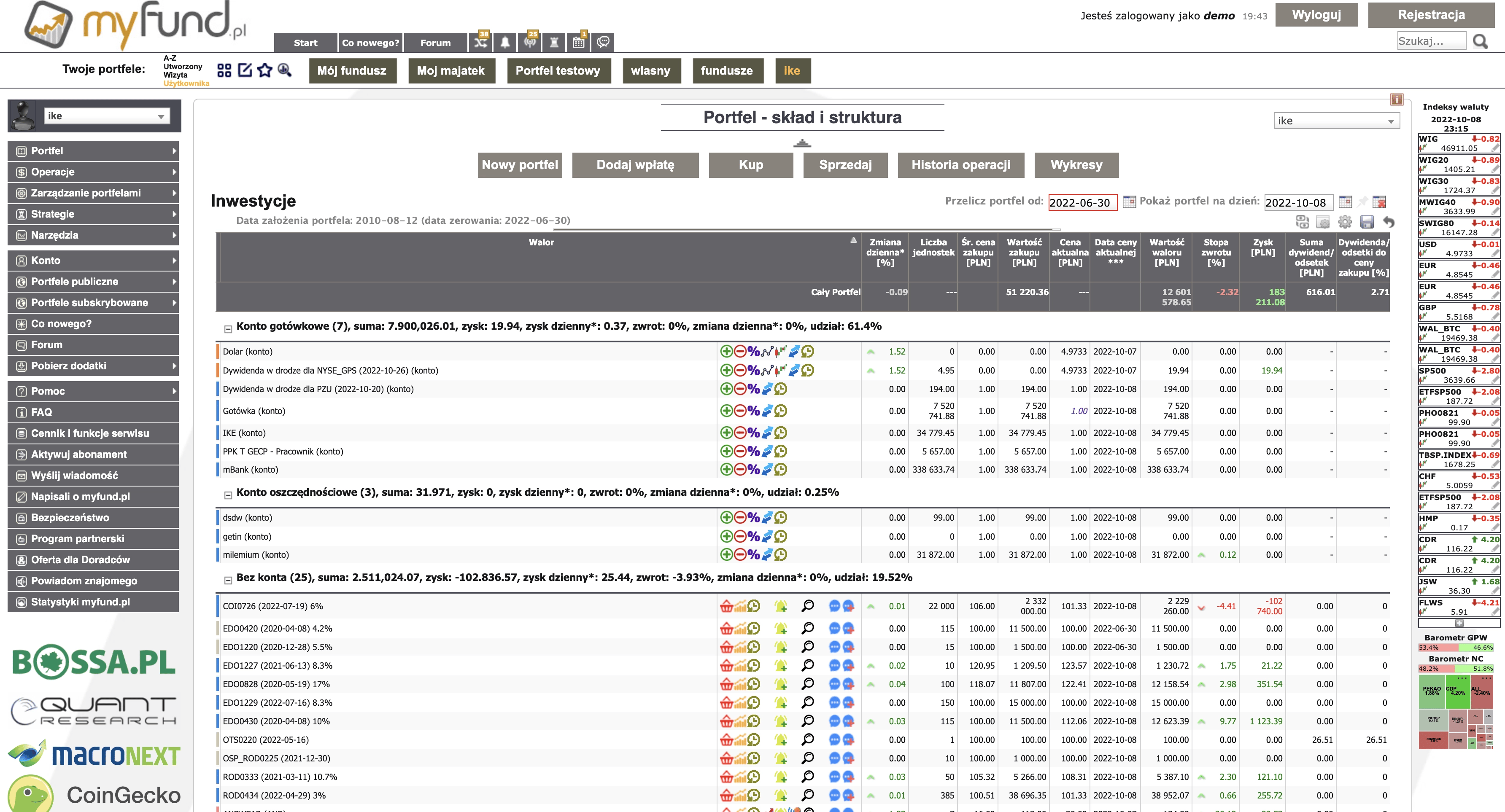
Capitally features a modern, consistent, exploratory interface designed for quick checking and customization—you can set up tables, charts, time periods, and entire views exactly as you like. myFund is at the opposite end of the spectrum: its hallmark is an outdated, overly branched menu architecture where even long-term users often struggle to find their way around.
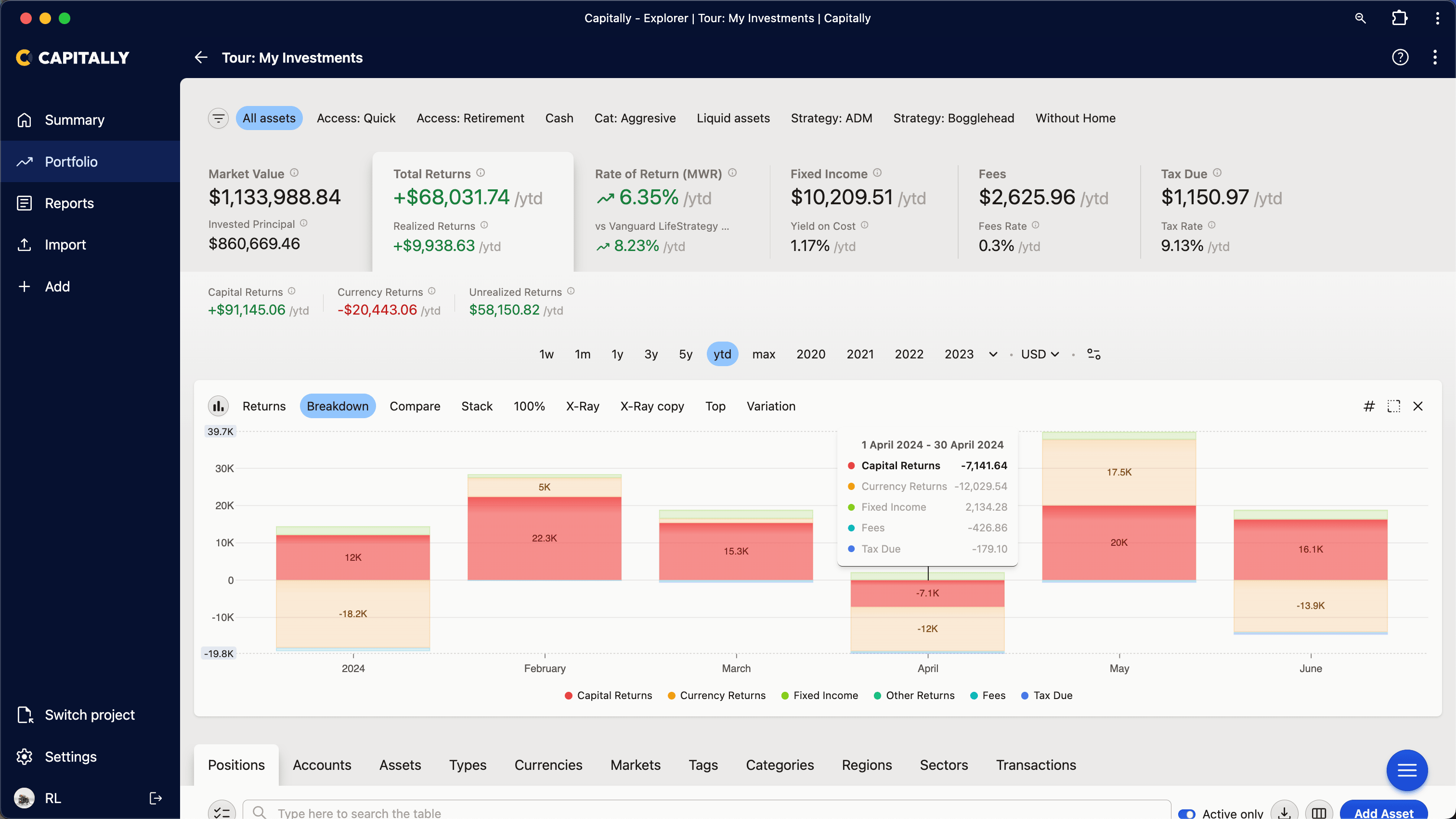
myFund is very feature-rich, but in practice, it feels more like a collection of functions than a cohesive product—it resembles a highly complex Excel spreadsheet that you have to learn how to navigate. It uses an "old layout" and a "new layout" in parallel, with the latter not differing significantly from the former and featuring low visual quality by modern standards. Capitally goes in the opposite direction: instead of hundreds of separate screens, it provides one cohesive analysis environment (Portfolio Explorer), delivered as a web app/PWA—you can install it on your desktop and phone, it works offline, and it has both light and dark modes.
In terms of ease of use, consistency, and modernity, Capitally is the clear winner. myFund makes up for this with the sheer number of features—if you are looking for a specific, niche report, you will likely find it there, provided you can reach it.
Polish market coverage and asset classes
myFund is unrivaled in its coverage of the Polish market: it supports stocks and ETFs from the WSE and NewConnect, bonds from Catalyst, mutual funds, and, most importantly, it has dedicated support for IKE, IKZE, PPK, OFE, and PPE accounts, including tracking contribution limits. Capitally allows you to add, label, and group these accounts with the rest of your portfolio, but it does not track contribution limits.
The full Polish offering of myFund includes instruments from the WSE and NewConnect, Catalyst bonds, investment and insurance funds, structured products, as well as foreign markets (NYSE, NASDAQ, LSE, and others). For an investor whose portfolio revolves around Polish retirement accounts, this is a massive advantage—and the main reason why myFund remains the benchmark in the Polish market.
Capitally makes up for this with breadth that myFund lacks: over 400,000 instruments from around the world and asset classes you won't find in myFund in the same form—private equity (a dedicated asset type with a full investment lifecycle), options (calls and puts, long and short, with valuation and "the Greeks"), liabilities, loans, and mortgages as fully-fledged assets, as well as short positions and margin. To be fair, there is another side: Capitally handles IKE, IKZE, and PPK accounts as fully-fledged account types—you can add, label, and group them with the rest of your portfolio—but it does not track contribution limits or fetch automatic valuations for closed-end funds or PPK; this can be worked around, but it is not as convenient as automatic fetching. The same applies to corporate and government bonds on Catalyst (though regular retail bonds have full support). It is in these specific areas that myFund is stronger, not in the general support of these accounts. Capitally is therefore well-suited for a portfolio ranging from government bonds to accounts at Interactive Brokers.
If your portfolio is primarily WSE and retirement accounts—myFund. If you have non-standard assets, foreign instruments, or liabilities to track—Capitally.
Tax handling: PIT-38, foreign dividends, IKE/IKZE
Tax handling is an area where the choice depends on where you invest. myFund features a PIT-38 calculator built from the ground up for the Polish tax system. Capitally has a tax engine covering 11 jurisdictions—including Poland in D-1 and D+1 variants—and automatically converts foreign dividends into PLN at the NBP exchange rate as of day D-1.
The PIT-38 calculator in myFund includes capital gains from stocks, funds, and bonds, carry-forward of losses from previous years, foreign dividends with withholding tax credit, cryptocurrency tax, interest from foreign deposits, and tax on bond coupons. There is also a tool for tax optimization that suggests which positions to sell before the end of the year. Limitations: FIFO method only and no tax engine for other countries—outside of Poland, these calculations do not apply.
Capitally calculates capital gains tax using ready-made presets for 11 countries (USA, UK, Netherlands, Poland, Czech Republic, Australia, Belgium, Canada, Germany, France, Sweden). It provides six cost-basis methods—FIFO, LIFO, highest and lowest cost, average cost, and manual lot selection—configurable at the asset, account, or individual position level. You can even create your own preset or modify an existing one to match your specific logic needs. There is also tax-loss harvesting in the form of a column indicating exactly how many shares to sell to achieve your intended tax "gain."
A separate issue for Polish investors is foreign dividends. Many Polish brokers—for example, Bossa or mBank eMakler—do not include dividends from the USA, Germany, or France in the PIT-8C form, so you must account for them yourself in your PIT-38. Capitally records the gross amount, withholding tax, and net amount, converts everything to PLN at the NBP rate, and compiles them into a report ready for dividend settlement. myFund also supports foreign dividends with withholding tax credit within PIT-38—this is a strong point shared by both apps, regardless of whether you use XTB or another broker.
Brokers and data import
myFund operates on a "one parser per broker" model: the creator maintains a separate importer for each broker and updates it when the broker changes their file format. This works great for supported brokers, but there is no flexible import for your own data—no column mapping, no saved user templates. The AI Portfolio Wizard attempts to recognize unknown formats, but it is a fresh and untested solution over which you have limited control.
Capitally supports over 70 brokers, exchanges, and apps around the world—from Interactive Brokers and Degiro to XTB, Bossa, Government Bonds, and Coinbase—based on statements. The key difference lies elsewhere: the Capitally importer maps any CSV, Excel, JSON, or XML file—with logic, formulas, and real-time price fetching. You save configurations as presets and use them again, create variants per account, and you can undo a failed import with a single click. This allows you to load a full, non-standard history—including from brokers not on the list, as well as for your own assets and your own data sources. In practice, myFund does not offer this.
A shared strength: neither app uses banking aggregators or requires you to provide passwords to your brokerage accounts—in both cases, you decide what and when you upload.
So, if you have a lot of your own data, non-standard formats, or foreign brokers—Capitally is significantly more flexible.
Pricing and real value
myFund is significantly cheaper: four plans cost from about 36 to 153 PLN per year, with a 30-day trial period. Capitally has three plans—Sailor (€80), Navigator (€130), and Captain (€250 per year)—with a 14-day, fully functional trial that does not require a credit card.
myFund plans (Basic, Standard, Pro, Expert) can be paid annually, semi-annually, or monthly, with no automatic renewal, and your data remains even after the subscription expires. For an investor with simpler needs, this is a very low barrier to entry.
Capitally costs more, but subscribers "freeze" their rate for the duration of their subscription. Whether the higher price pays off depends on how many of Capitally's features you actually use—end-to-end encryption, taxes for multiple countries, flexible import, and deep analytics. For a portfolio held in a single Polish brokerage account, the price difference is hard to justify; for a complex, international portfolio, it quickly becomes secondary.
If the lowest cost is what matters—myFund. If you look at what you get for the price and need advanced features—Capitally definitely defends its valuation and is still cheaper than international competitors.
What you won't find in either app
Neither Capitally nor myFund are trading platforms—you cannot buy stocks through them, and they are not for day trading. Both focus on tracking and analyzing your portfolio after the fact, not on executing trades.
It is also worth noting what Capitally specifically lacks compared to myFund: there are no stock watchlists and price alerts (only scheduled summary notifications exist), no fundamental analysis or stock screener, no technical analysis indicators, and no API access. myFund, on the other hand, lacks end-to-end encryption, custom charts, and saved reports; it only supports the FIFO method and does not know tax laws for countries other than Poland. If you are considering other tools as well, check out our comparisons with Sharesight, Kubera, and Snowball Analytics.
How to move from myFund to Capitally
Moving from myFund to Capitally is simple because Capitally has a dedicated myFund import feature. You can transfer your entire portfolio (accounts, transactions, and dividends) or just your transaction history, depending on how much history you want to keep.
- Entire portfolio — accounts, transactions, and dividends. In myFund, open Portfolio Management → Your Portfolios → Export selected portfolio and export it to XML format.
- Or just transactions. In myFund, open Portfolio → Transaction History and click Export to xls or Export to csv.
- Load the file into Capitally. Drag the exported file into Capitally—the dedicated import will recognize accounts, transactions, and dividends from myFund without manual column mapping.
- Reconcile balances. Compare the number of holdings and cash balances with your latest statement to ensure nothing was missed.
- Set the tax preset for Poland. Select the Polish preset (D-1 or D+1) so that tax reports are ready for your PIT-38.
For the best quality of imported data, use imports directly from your brokers, and fill in gaps only with data from myFund that is otherwise unavailable.
Is it worth switching? If your portfolio is entirely Polish, simple, and based on IKE/IKZE—myFund is likely still perfectly adequate for you. If you have added foreign accounts, additional currencies, or non-standard assets, and you care about privacy—this is a good time to test Capitally with a 14-day trial using your own data.
Verdict: who is Capitally for, and who is myFund for?
There is no single winner here—Capitally and myFund target two different investor profiles, and both do so in their own way.
Who is myFund for? myFund is the best choice for a Polish investor whose portfolio revolves around the WSE, mutual funds, and IKE/IKZE/PPK retirement accounts. You get a mature tool, proven since 2009, a ready-made PIT-38 calculator, fundamental analysis and a stock screener, and a large, active community—all at the lowest price on the market. In return, you accept an outdated, cluttered interface and limited flexibility outside of the Polish market.
Who is Capitally for? Capitally is a better choice if your portfolio extends beyond a single Polish account. It is built for the investor who holds accounts with foreign brokers, invests in multiple currencies, holds non-standard assets—private equity, options, real estate, liabilities—and treats data privacy as a non-negotiable requirement. You get end-to-end encryption, which myFund lacks, a tax engine for many countries, flexible import for any data, and modern, interactive analytics. It is also worth noting that a simpler interface often enables better utilization of the functionality the system offers.
No. myFund uses standard server-side encryption and hosting in Poland—this is solid protection, but the operator technically has access to your data. Capitally is the only one of the two that offers end-to-end encryption on your device using a zero-knowledge model, where even the Capitally team cannot read your portfolio.
You report foreign dividends in PIT-38 yourself because many Polish brokers do not include them in the PIT-8C. You need the gross amount, the withholding tax, and the conversion to PLN at the NBP rate as of day D-1. Capitally records these values automatically and compiles them into a report ready for your PIT-38; myFund also supports foreign dividends with withholding tax credit.
Yes, although differently than myFund. Capitally allows you to add IKE and IKZE accounts, label them, and group them with the rest of the portfolio, but it does not track annual contribution limits. myFund has dedicated support for IKE, IKZE, and PPK with contribution limit tracking—for an investor focused on retirement accounts, this is a real advantage.
myFund is clearly cheaper, ranging from approximately 36 to 153 PLN per year, depending on the chosen plan. Capitally costs 80, 130, or 250 € per year. In return, Capitally offers end-to-end encryption (E2EE), tax support for 11 countries, and flexible Data Import — whether this price difference is worth it depends on the complexity of your portfolio.
Yes — Capitally has a dedicated tool for importing data from myFund. In myFund, export your entire portfolio to an XML file (Portfolio Management → Your portfolios → Export selected portfolio) or your transaction history to an XLS/CSV file (Portfolio → Transaction history), and then upload the file to Capitally. Your accounts, Transactions & dividends will be automatically recognized, without the need for manual column mapping.